

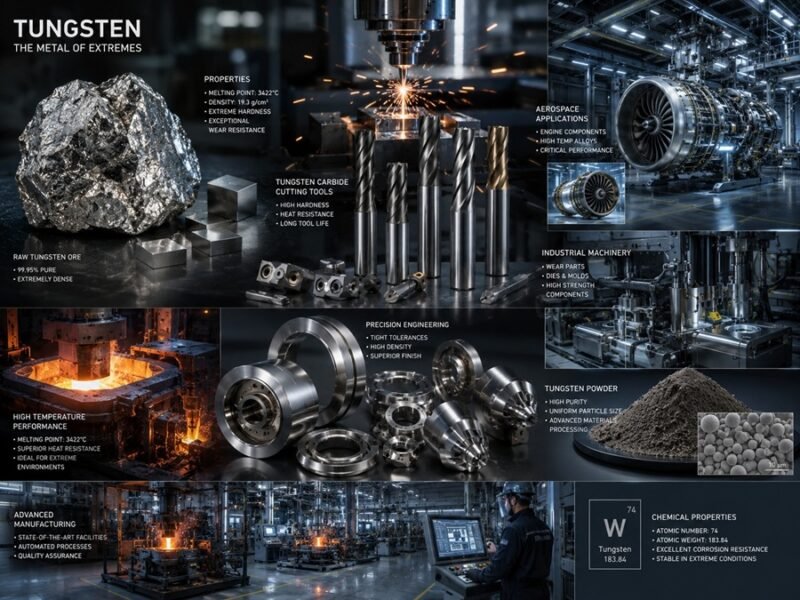
Few metals on Earth can match the extraordinary capabilities of tungsten volfram. Known by the chemical symbol W, this silver-white metal holds the record for the highest melting point of any pure element and delivers a combination of strength, density, and heat resistance that no other material can replicate.
Whether you’re an engineer designing jet components, a manufacturer sourcing cutting tools, or simply curious about the materials shaping modern technology — tungsten matters. It silently powers everything from the filament in a light bulb to armor-piercing military projectiles, from medical radiation shields to semiconductor manufacturing equipment.
One point of common confusion: “wolfram” and “tungsten” are the exact same element. The name varies by region and language, but the metal is identical. Understanding both terms helps when sourcing materials globally or reading international technical literature.
In this guide, we cover everything you need to know about tungsten volfram — its properties, how it’s produced, where it’s used, and why demand is rising as industries evolve into 2026 and beyond.
What Is Tungsten Volfram?
Tungsten (chemical symbol: W, atomic number: 74) is a naturally occurring metallic element found in the transition metals group of the periodic table. It belongs to the category of refractory metals — materials characterized by exceptional resistance to heat and wear.
Discovery and History
Tungsten was first identified in 1781 by Swedish chemist Carl Wilhelm Scheele, who isolated tungstic acid from the mineral scheelite. Two years later, in 1783, Spanish brothers Juan José and Fausto Elhuyar successfully isolated the pure metal for the first time.
Why Is It Called Wolfram?
The name wolfram comes from the mineral wolframite (iron-manganese tungstate), which was the primary ore from which tungsten was first extracted. In German, Scandinavian, and several European languages, the element is still officially called “wolfram” — hence the chemical symbol W. The name “tungsten” itself derives from the Swedish words tung (heavy) and sten (stone), meaning “heavy stone.”
Today, both names are used internationally:
- Tungsten — preferred in English-speaking countries
- Wolfram / Volfram — used across Germany, Russia, Eastern Europe, and much of the world
Physical and Chemical Properties of Tungsten
Tungsten’s industrial dominance comes directly from its remarkable physical and chemical profile. No other metal combines these properties at the same level.
Properties at a Glance
| Property | Value |
|---|---|
| Atomic Number | 74 |
| Chemical Symbol | W |
| Melting Point | 3,422°C (6,192°F) — highest of all pure metals |
| Boiling Point | 5,555°C (10,031°F) |
| Density | 19.3 g/cm³ (nearly twice that of lead) |
| Color | Steel-gray to tin-white |
| Hardness (Mohs) | 7.5 |
| Thermal Conductivity | 173 W/(m·K) |
| Electrical Conductivity | ~18.9 × 10⁶ S/m |
| Common Forms | Powder, rod, wire, sheet, carbide compounds |
Key Property Highlights
Extreme Melting Point: At 3,422°C, tungsten melts at a temperature so high that virtually no furnace can damage it under normal industrial conditions. This makes it irreplaceable in high-temperature environments.
Exceptional Density: At 19.3 g/cm³, tungsten is nearly as dense as gold and significantly denser than lead. This density is critical in applications requiring counterweights and radiation shielding.
Outstanding Hardness: Tungsten’s natural hardness, and especially the hardness of tungsten carbide (rated 9–9.5 on the Mohs scale), makes it among the hardest industrial materials available.
Low Thermal Expansion: Tungsten expands very little when heated, maintaining dimensional stability even at extreme temperatures — a crucial property for precision manufacturing components.
Corrosion Resistance: At room temperature, tungsten resists attack from most acids, alkalis, and oxygen. It only begins to oxidize significantly above 400°C.
How Tungsten Is Produced
Mining and Ores
The two primary tungsten-bearing minerals are:
Wolframite [(Fe,Mn)WO₄] — an iron-manganese tungstate ore, typically found in quartz veins and granite pegmatites.
Scheelite [CaWO₄] — a calcium tungstate ore that fluoresces bright blue-white under ultraviolet light, making it easier to detect during mining operations.
Global Production
China dominates global tungsten production, accounting for roughly 80% of the world’s supply. Other significant producers include Russia, Vietnam, Canada, and Bolivia. The concentration of supply in China has led many industries to prioritize recycling and develop alternative sourcing strategies.
Refining Process
After mining, tungsten ore is processed into ammonium paratungstate (APT), which serves as the intermediate feedstock for most downstream tungsten products. APT is then converted into tungsten oxide and subsequently reduced with hydrogen to produce tungsten metal powder.
Powder Metallurgy
Most tungsten products are manufactured through powder metallurgy — a process where fine tungsten powder is pressed into desired shapes and then sintered (heated just below the melting point) to bond the particles together. This technique allows precise control over composition, density, and mechanical properties, making it ideal for producing complex industrial components.
Top Industrial Uses of Tungsten Volfram
1. Aerospace Industry
Tungsten’s ability to withstand extreme temperatures makes it a cornerstone material in aerospace engineering.
Rocket nozzles manufactured from tungsten or tungsten-rhenium alloys can endure the intense heat and erosive forces of rocket propulsion. Heat shields and re-entry vehicle components rely on tungsten’s thermal stability to protect spacecraft during atmospheric entry. Aircraft counterweights and gyroscope components take advantage of tungsten’s exceptional density, allowing engineers to concentrate mass in small volumes.
2. Automotive Industry
Modern high-performance vehicles use tungsten in several key applications. Engine balancing weights made from tungsten alloys offer superior mass concentration in tight spaces compared to conventional materials. Crankshaft counterweights and vibration dampers benefit from the metal’s high density. Additionally, tungsten carbide is widely used in valve seat inserts, extending engine component lifespan significantly.
3. Construction & Manufacturing — Cutting Tools
This is tungsten’s single largest application sector. Tungsten carbide cutting tools — including drill bits, end mills, turning inserts, and saw blades — are essential to virtually every metal-cutting and machining operation on the planet. Tungsten carbide’s hardness allows tools to maintain sharp cutting edges far longer than high-speed steel alternatives, dramatically improving production efficiency and reducing downtime.
Mining and drilling equipment also relies heavily on tungsten carbide for rock drill bits and tunnel boring machine cutters that must withstand punishing abrasion.
4. Electronics Industry
Tungsten was historically the material that made the electric light bulb possible. Even today, it remains critical in electronics:
Incandescent and halogen lamp filaments use tungsten wire because no other material can glow white-hot without melting. Electrical contacts and electrodes in arc welding equipment benefit from tungsten’s heat resistance and low erosion rate. In semiconductor manufacturing, tungsten is used to form electrical interconnects within microchips — the tiny conductive pathways that link transistors in modern processors.
5. Medical Applications
Healthcare is a growing market for tungsten, particularly in radiation shielding. Tungsten’s high density makes it an excellent barrier against X-ray and gamma radiation — and unlike lead, it is non-toxic, making it increasingly preferred for shielding in hospitals and medical laboratories. Collimators in CT scanners and radiation therapy equipment rely on tungsten’s density and machinability. Radiation containers for transporting radioactive isotopes are another key medical use.
6. Defense & Military Applications
Tungsten has replaced lead and depleted uranium in many military applications due to its density and performance characteristics. Armor-piercing projectiles made from tungsten heavy alloys penetrate armored targets with exceptional effectiveness. Kinetic energy penetrators in tank ammunition and anti-drone munitions use tungsten alloy rods for their mass and hardness. Fragmentation warheads and shaped charge liners also incorporate tungsten.
7. Energy & Industrial Heating
High-temperature industrial furnaces used for melting metals, sintering ceramics, and processing specialty materials rely on tungsten heating elements that can operate above 2,000°C. In the nuclear energy sector, tungsten is evaluated as a plasma-facing material for fusion reactors, particularly in ITER and next-generation fusion projects, due to its ability to withstand extreme heat flux without excessive erosion.
Tungsten Carbide Explained
Tungsten carbide (WC) is a chemical compound formed by combining tungsten and carbon atoms. It is one of the hardest and most wear-resistant materials known, second only to diamond in hardness on a practical industrial scale.
Rated at 9 to 9.5 on the Mohs hardness scale, tungsten carbide is used almost everywhere that extreme wear resistance is needed. When combined with a metallic binder (typically cobalt), it forms a composite material called cemented carbide or hard metal — the gold standard for cutting tools, mining equipment, and wear parts.
Key advantages of tungsten carbide include its exceptional abrasion resistance, compressive strength, and ability to maintain its edge sharpness even at elevated cutting temperatures. A tungsten carbide drill bit can outlast a high-speed steel bit by a factor of 10 to 30 in demanding applications.
Advantages of Tungsten Volfram
Tungsten’s appeal across so many industries comes down to a consistent set of advantages:
Extreme durability — Components made from tungsten last significantly longer than alternatives, reducing replacement frequency and lifecycle costs.
Unmatched heat resistance — The highest melting point of any pure metal gives tungsten an irreplaceable role wherever temperatures are extreme.
Wear resistance — Especially in carbide form, tungsten withstands abrasion that destroys other materials.
High strength under pressure — Tungsten maintains structural integrity under enormous compressive loads.
Long service life — In industrial applications, tungsten components often deliver 5–10 times the service life of conventional materials.
Dimensional stability — Low thermal expansion ensures precision components remain accurate even when subjected to thermal cycling.
Limitations and Challenges
Despite its remarkable properties, tungsten presents real challenges that engineers and procurement professionals must account for:
High cost — Tungsten is significantly more expensive than steel or aluminum. The price of tungsten oxide fluctuates with global supply and geopolitical factors, particularly given China’s dominant position in production.
Difficult machining — Tungsten’s hardness makes it hard to machine using conventional equipment. Specialized diamond tools, electrical discharge machining (EDM), and grinding are typically required.
Brittleness — Pure tungsten can be brittle at room temperature, particularly in its sintered powder form. Alloying with rhenium, nickel, or iron is often necessary to improve ductility for demanding applications.
Environmental concerns — Mining tungsten ore has significant land-use and water-quality impacts. Responsible sourcing and recycling have become increasingly important.
Supply chain concentration — Over-reliance on Chinese production creates supply chain vulnerability that manufacturers in North America, Europe, and Asia-Pacific are actively working to mitigate.
Tungsten vs Other Metals — Comparison
| Property | Tungsten | Steel | Titanium | Aluminum | Copper |
|---|---|---|---|---|---|
| Melting Point (°C) | 3,422 | ~1,370 | 1,668 | 660 | 1,085 |
| Density (g/cm³) | 19.3 | 7.8 | 4.5 | 2.7 | 8.9 |
| Hardness (Mohs) | 7.5 | 4–4.5 | 6 | 2.5–3 | 2.5–3 |
| Corrosion Resistance | Excellent | Moderate | Excellent | Good | Good |
| Thermal Conductivity | High | Medium | Low | Very High | Very High |
| Key Applications | Cutting tools, aerospace, defense | Structural, general engineering | Aerospace, medical | Packaging, transport | Electrical, plumbing |
| Relative Cost | Very High | Low | High | Low | Medium |
Sustainability & Recycling
Tungsten is one of the most recyclable industrial metals, and recycling has become a strategic priority given supply chain concerns and rising demand.
Secondary tungsten — recovered from scrap cutting tools, grinding sludge, and used components — now accounts for roughly 30–40% of global tungsten supply in mature industrial economies. The recycling process typically involves chemical dissolution, precipitation, and reprocessing back to ammonium paratungstate, the same intermediate used in primary production.
Sustainable mining innovations are also advancing. Sensor-based ore sorting, reduced-water leaching processes, and tailings reprocessing are lowering the environmental footprint of tungsten extraction. The European Union has designated tungsten a Critical Raw Material, prompting investment in domestic recycling infrastructure.
The circular economy model is particularly well-suited to tungsten, since used cemented carbide tools retain most of their tungsten value and can be efficiently recovered and reused.
Future of Tungsten in Modern Technology
Looking ahead to 2026 and beyond, tungsten demand is set to grow in several high-growth sectors:
Electric Vehicles (EVs): Tungsten is used in electric motor components, high-voltage contacts, and the precision machining tools needed to manufacture EV drivetrains at scale.
Renewable Energy: Wind turbine manufacturing requires tungsten carbide tooling for machining large precision components. Solar panel production equipment also uses tungsten in high-temperature process chambers.
Semiconductor and Advanced Electronics: As chip geometries shrink to 2nm and below, tungsten’s role as an interconnect material in multi-layer chip architectures becomes more critical. Deposition of tungsten thin films is a standard step in leading-edge chip fabrication.
AI Hardware and Robotics: The infrastructure powering AI — data centers, GPU servers, and robotic automation systems — relies on precision-machined components where tungsten carbide tooling is standard.
Aerospace and Space Exploration: Next-generation rocket engines, hypersonic vehicle components, and satellite systems all benefit from tungsten’s heat resistance and dimensional stability.
Fusion Energy: Projects like ITER and commercial fusion startups are qualifying tungsten as a plasma-facing material. If commercial fusion energy becomes viable in the 2030s, tungsten demand in the energy sector could grow substantially.
Expert Insights for Industrial Buyers and Engineers
Selecting the right grade: Not all tungsten is the same. For cutting tools, specify the appropriate cobalt binder content and grain size for your application — finer grain sizes improve hardness and edge retention, while higher cobalt content improves toughness. For high-temperature applications, consider tungsten-rhenium alloys for improved ductility at extreme temperatures.
Industrial sourcing considerations: Diversify your supply chain beyond single-country sources. Request material certifications (chemistry, density, hardness) from suppliers and verify against applicable standards (ISO 513, ASTM B777 for tungsten alloys).
Machining and maintenance: When working with tungsten carbide components, use proper coolant strategies to prevent thermal shock and cracking. Inspect tools regularly for micro-chipping, which, if caught early, can often be addressed by regrinding rather than full replacement.
Performance optimization: In wear applications, match the tungsten carbide grade to the specific abrasion mechanism — erosive wear, adhesive wear, and impact loading all favor different grades. Consulting with a material supplier’s applications engineer before finalizing specifications can prevent costly misspecification.
Conclusion
Tungsten volfram stands as one of humanity’s most indispensable industrial metals. From enabling the first practical light bulbs to powering modern jet engines, from protecting patients in medical facilities to cutting through the hardest materials in precision manufacturing — tungsten is everywhere that performance matters most.
Its combination of the world’s highest melting point, exceptional density, unmatched hardness in carbide form, and remarkable corrosion resistance places it in a category that no other metal can fully replicate. Even with the challenges of high cost, difficult machining, and supply concentration, the advantages tungsten delivers consistently outweigh the drawbacks across virtually every demanding application.
As the world moves toward electrification, advanced manufacturing, AI infrastructure, and sustainable energy, tungsten demand will not diminish — it will grow. Engineers, manufacturers, and researchers who understand this metal’s full capabilities will be better positioned to design superior products, optimize production processes, and build the technologies that define the next decade.
Tungsten isn’t just a legacy material of 20th-century industrialization. It is, increasingly, a foundational material for 21st-century innovation.
Frequently Asked Questions (FAQs)
Q: What is tungsten volfram used for?
Tungsten volfram is used in cutting tools, aerospace components, military ammunition, medical radiation shielding, electrical contacts, filaments, semiconductor manufacturing, automotive counterweights, and high-temperature industrial furnaces. Its applications span nearly every sector of heavy industry.
Q: Is tungsten stronger than steel?
In terms of tensile strength, high-grade steel alloys can match or exceed pure tungsten. However, tungsten surpasses steel in hardness, melting point, density, and wear resistance — making it far superior for high-temperature, high-wear, and high-density applications.
Q: Why is tungsten called wolfram?
Tungsten was first isolated from the mineral wolframite, and German-speaking scientists who performed much of the early research named it “wolfram.” The name and chemical symbol W were established before the English name “tungsten” became widely adopted. Both names remain in official use internationally.
Q: What makes tungsten heat resistant?
Tungsten’s heat resistance stems from its extremely strong metallic bonds and its high atomic mass. The strong interatomic bonding requires enormous energy to break, giving tungsten its record-breaking melting point of 3,422°C.
Q: Is tungsten expensive?
Yes, tungsten is significantly more expensive than common engineering metals like steel or aluminum. Prices fluctuate based on Chinese production levels, global demand, and secondary market recycling volumes. However, tungsten’s long service life often makes it cost-effective over the full lifecycle of a component.
Q: What industries use tungsten the most?
The metalworking and manufacturing industry (cutting tools) is the largest consumer of tungsten. This is followed by the oil and gas industry (drilling equipment), aerospace, automotive, defense, electronics, and medical sectors.
Q: What is tungsten carbide?
Tungsten carbide (WC) is a compound of tungsten and carbon, typically mixed with a cobalt binder to create cemented carbide. It is one of the hardest industrial materials available, rated 9–9.5 on the Mohs scale, and is the material of choice for cutting tools, drill bits, and wear-resistant industrial components.
Q: Is tungsten recyclable?
Yes. Tungsten is highly recyclable, and the recycling industry is well-established. Used cutting tools, grinding sludge, and worn components can be chemically reprocessed back to pure tungsten compounds with minimal material loss. Recycled tungsten accounts for a significant portion of global supply.
Must Read: Complete Guide to Choosing the Best Solar Panel Kit for Home Use
