

Electricity bills are climbing every year, and many homeowners are done waiting for prices to drop. Whether you’re looking to reduce monthly costs, become less dependent on the grid, or simply make a greener choice, solar energy has moved from a luxury to a practical, accessible option.
One of the simplest entry points? A solar panel kit.
Unlike buying individual components separately or hiring an installer to design a custom system from scratch, solar panel kits give you everything bundled together — tested, matched, and ready to deploy. In the last few years, they’ve become increasingly popular with both homeowners and renters, including people setting up power for RVs, cabins, and off-grid properties.
This guide will walk you through everything you need to know — how these kits work, what types exist, how to pick the right one, and how to avoid the most common buying mistakes.
What Is a Solar Panel Kit?
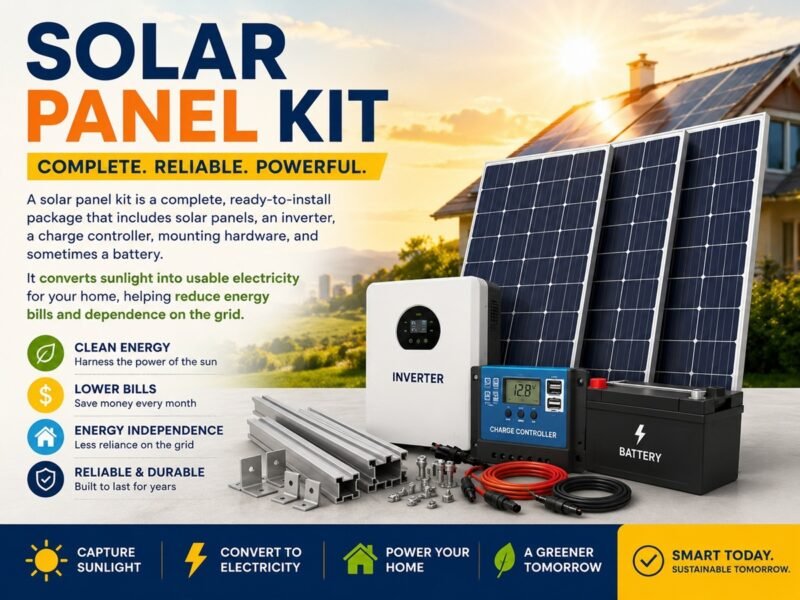
A solar panel kit is a pre-packaged set of components designed to work together as a complete solar energy system. Instead of sourcing a panel from one manufacturer, an inverter from another, and a charge controller elsewhere — and then hoping they’re all compatible — a kit gives you everything in one box.
Most standard kits include:
- Solar panels (one or more, depending on system size)
- Inverter (to convert DC power to usable AC power)
- Charge controller (to regulate battery charging)
- Mounting hardware (brackets, rails, and fasteners)
- Wiring and connectors
- Battery storage (in some kits, especially off-grid versions)
Think of it like buying a furniture set vs. individual pieces — a kit ensures everything fits and functions together. It also simplifies the buying process, especially for first-timers.
How Do Solar Panel Kits Work?
Understanding the basic process helps you make smarter decisions when comparing options. Here’s how a typical home solar panel kit works, step by step:
Step 1 — Sunlight Hits the Panels
Solar panels are made of photovoltaic (PV) cells, usually silicon-based. When sunlight hits these cells, electrons start moving, generating direct current (DC) electricity.
Step 2 — The Inverter Converts the Power
Your home appliances run on alternating current (AC), not DC. The inverter converts the raw solar electricity into a form your home can actually use.
Step 3 — Electricity Flows to Your Home (or Battery)
If you’re grid-tied, surplus electricity goes back to the grid. In off-grid and hybrid systems, excess energy is stored in batteries for use at night or during outages.
Step 4 — The Charge Controller Protects Your Battery
In systems with battery storage, a charge controller regulates how much power flows in and out of the battery. It prevents overcharging, which can damage or shorten battery life significantly.
Step 5 — The Mounting System Holds Everything in Place
Panels are secured to your roof (or ground, or RV) with a mounting system — typically aluminum rails and brackets designed for durability and weather resistance.
Types of Solar Panel Kits
Not every kit is built for the same purpose. Understanding the main types helps you narrow down what’s right for your situation.
Grid-Tied Solar Kits
These systems connect directly to your utility grid. During the day, you use solar power; at night, you draw from the grid. If you generate more than you use, the excess is often sold back to your utility company through net metering.
Best for: Homeowners in urban or suburban areas with reliable grid access.
Off-Grid Solar Kits
Designed for complete energy independence. These kits include battery storage and are built to power your home without any grid connection. They require more planning and a larger battery bank.
Best for: Rural homes, cabins, farms, and remote properties.
Hybrid Solar Kits
A combination of grid-tied and off-grid. You stay connected to the grid but also have battery backup. During a power outage, your home stays powered — a growing priority for many families after weather-related disruptions.
Best for: Homeowners who want energy independence and grid reliability as a safety net.
RV Solar Panel Kits
Compact and designed for mobility, RV solar panel kits are mounted on the roof of a recreational vehicle. They typically run smaller loads — lights, phone charging, a mini-fridge — rather than powering a full home setup.
Best for: Road travelers, van lifers, and campers.
Portable Solar Kits
Lightweight and foldable, portable kits are meant for temporary use — camping trips, emergency preparedness, or powering small devices on the go. They’re not designed for permanent home installation.
Best for: Outdoor enthusiasts and emergency backup use.
Best Solar Panel Kits for Home Use — What to Look For
There’s no single “best” kit for everyone. It depends on your energy needs, roof type, budget, and future plans. Here are the key factors to evaluate:
Power Output (Wattage)
A small home might need 3–5 kW, while a larger property with heavy appliances could need 8–12 kW or more. Always calculate your average monthly energy use (check your electricity bill) before choosing a kit.
Panel Efficiency
Higher efficiency means more electricity from the same roof space. Monocrystalline panels typically offer 20–23% efficiency — the best for residential use. Polycrystalline panels are cheaper but slightly less efficient.
Warranty Coverage
Look for panels with a 25-year performance warranty and at least a 10-year product warranty. Inverters usually come with 5–12 year warranties. These numbers tell you a lot about the manufacturer’s confidence in their product.
Expandability
Some kits are designed to grow with you — you can add more panels or a larger battery later. If you think you’ll need more power down the road (electric vehicle charging, for example), prioritize an expandable system.
Ease of Installation
Many kits are marketed as do-it-yourself solar panel kits, with detailed instructions and pre-drilled mounting hardware. If you’re planning a DIY install, look for kits with good technical support and step-by-step documentation.
DIY Solar Panel Kits vs. Professional Installation
The Case for DIY
DIY home solar panel kits have become increasingly viable for handy homeowners. The main appeal is cost — you can save ₹50,000 to ₹1,50,000 (or $1,500–$5,000+ in the US) on labor. Many manufacturers offer pre-wired kits with color-coded connectors that simplify installation considerably.
DIY makes the most sense when:
- You’re installing on a simple, single-story roof
- You have basic electrical and handyperson skills
- The system is small (under 3–5 kW)
- Local permits allow homeowner-installed systems
When to Hire a Professional
For larger systems, complex roofs, or in areas where electrical work requires a licensed contractor, professional installation is the smarter (and sometimes legally required) choice. A certified installer also handles permits, utility interconnection agreements, and may be required to access certain government incentives or rebates.
Bottom line: DIY saves money upfront; professional installation offers peace of mind, warranty protection, and regulatory compliance.
Benefits of Installing Solar Panel Kits
Here’s why millions of homeowners globally are making the switch:
- Lower electricity bills — Most solar homeowners see 50–90% reductions in monthly energy costs, depending on system size and local rates.
- Energy independence — With battery storage, you’re less vulnerable to grid outages, rate hikes, and supply disruptions.
- Eco-friendly impact — Solar energy produces zero emissions during operation. A typical home system offsets several tonnes of CO₂ per year.
- Backup power — Hybrid and off-grid kits keep your home running during blackouts — a feature that’s growing in value as extreme weather becomes more common.
- Long-term savings — With a lifespan of 25+ years, most solar systems pay for themselves within 6–10 years, then generate essentially free electricity for decades.
Common Mistakes to Avoid When Buying Solar Kits
Even well-intentioned buyers make these errors. Learn from them before you spend.
Buying an undersized system. Many first-timers underestimate their energy needs. Always calculate your actual consumption and add a 20–25% buffer for growth or seasonal variation.
Ignoring roof compatibility. Not all roofs are solar-friendly. Older roofs, heavily shaded areas, or structurally weak sections can cause problems. Always inspect your roof before purchasing.
Skipping battery planning. If you want backup power, you need a battery-compatible system. Don’t assume all kits include storage — many grid-tied kits do not.
Choosing low-quality panels to save money. Cheap panels degrade faster, produce less power, and may void warranties. Stick with reputable brands that offer transparent efficiency and degradation data.
How Much Does a Solar Panel Kit Cost?
Price varies widely based on system size, brand, and whether you install it yourself.
| System Size | Typical Use Case | Estimated Cost (Kit Only) |
|---|---|---|
| 1–2 kW | Small apartment / backup | ₹60,000–₹1,20,000 |
| 3–5 kW | Average home | ₹1,50,000–₹3,00,000 |
| 6–10 kW | Larger home / EV charging | ₹3,00,000–₹6,00,000 |
| RV/Portable | Mobile use | ₹15,000–₹80,000 |
Note: These are kit-only estimates. Add ₹50,000–₹1,50,000+ for professional installation, if applicable. Government subsidies (like India’s PM Surya Ghar Yojana) can significantly reduce your out-of-pocket cost.
Factors that affect final pricing include: panel brand and efficiency, battery capacity, inverter type (string vs. microinverter), and local installation labor rates.
Are Solar Panel Kits Worth It?
For most homeowners, yes — especially with electricity rates continuing to rise.
The typical return on investment (ROI) for a home solar system falls between 6–10 years, after which you’re generating power at near-zero marginal cost. Over a 25-year panel lifespan, the total savings can easily reach ₹5–15 lakh or more for an average household.
Beyond the financial math, there’s real value in energy security. Knowing that your home can function independently during a grid failure — or that you’re not subject to unpredictable rate increases — has meaningful quality-of-life benefits that don’t always show up in a spreadsheet.
If you’re a renter, or if your energy use is very low, the calculus changes. But for homeowners with moderate-to-high consumption, a well-chosen solar panel kit is one of the most financially sound home improvements you can make.
Frequently Asked Questions
How many solar panels do I need for my home?
It depends on your monthly electricity consumption and the sunlight hours in your area. As a general rule, a 3–5 kW system (roughly 8–15 panels at 350–400W each) covers the average Indian home using 250–400 kWh per month. Check your electricity bill and use an online solar calculator to get a more precise estimate.
Can I install solar panels myself?
Yes, for smaller systems in many regions. Do-it-yourself solar panel kits are specifically designed for homeowner installation, with detailed guides and pre-matched components. However, electrical connections to your home’s main panel should always be done by or inspected by a licensed electrician to ensure safety and code compliance.
Do solar panel kits work during cloudy weather?
They do, but at reduced efficiency — typically 10–25% of their rated output on heavily overcast days. Modern high-efficiency panels are designed to capture diffuse light. If you live in a cloudy region, factor this into your system sizing and consider larger battery storage.
What is included in a solar installation kit?
A standard solar installation kit typically includes: solar panels, an inverter, a charge controller (for battery systems), mounting hardware, MC4 connectors, and wiring. Battery storage may or may not be included — always verify the kit’s contents before purchasing.
Are RV solar panel kits different from home systems?
Yes. RV solar panel kits are smaller (usually 100W–600W), more compact, and designed for mobile installation on a vehicle roof. They’re typically 12V or 24V systems suited for smaller loads, while home systems run at 48V or higher and handle full household consumption.
How long do solar panel kits last?
Quality solar panels are built to last 25–30 years, though efficiency gradually decreases over time (typically 0.5–1% per year). Inverters usually need replacement every 10–15 years. With proper maintenance, a well-installed solar kit can deliver reliable power for decades.
Is a permit required to install a solar panel kit?
In most regions, yes — especially for grid-tied systems. Requirements vary by country, state, and local municipality. Many DIY kit manufacturers provide guidance on the permit process. If you’re hiring a professional installer, they typically handle permitting as part of their service.
What’s the difference between a solar kit and buying PV panels for sale separately?
A kit ensures all components — panels, inverter, charge controller — are matched and compatible. Buying PV panels for sale separately gives you more flexibility to customize, but requires technical knowledge to ensure everything works together safely and efficiently.
Related Article: How to Get Affordable Solar Roof Tiles: A Practical Guide for Homeowners
Conclusion
Choosing the right solar panel kit doesn’t have to be complicated — but it does require a little homework upfront. The key is to start with your energy needs, understand your roof and location, and then match those realities to a kit that’s properly sized, reliably warranted, and built for your specific use case.
Whether you’re interested in a full off-grid setup, a grid-tied system with net metering, a hybrid solution with battery backup, or even an RV solar panel kit for life on the road — there’s a kit designed for your situation.
Before you buy, audit your electricity bills, check local incentives and subsidies, and if you’re unsure about installation, consult a certified solar professional. The upfront investment is real, but so are the 25 years of reduced (or eliminated) electricity bills that follow.
Solar isn’t the future anymore — it’s a very practical present. And for most homeowners, a good solar panel kit is the simplest, most accessible way to be part of it.
