

Written by Dr. Elena Voss, MA in Classics (University of Oxford), 8+ years researching Stoic philosophy and Roman antiquity. Reviewed by Prof. James Hartley, Department of Ancient History, King’s College London.
Last Updated: May 2026
Quick Answer: Memento mori is a Latin phrase meaning “Remember, you must die.” It is a Stoic and medieval philosophical reminder of human mortality — used not to depress, but to clarify what truly matters while we are alive.
People Also Ask
- What does memento mori mean in English?
- What language is memento mori?
- Where does memento mori come from?
- What is the difference between memento mori and memento vivere?
- Why do people get memento mori tattoos?
Memento mori means, quite literally, “Remember that you will die.” That sentence is uncomfortable — and that discomfort is the entire point. For the Roman Stoics, for medieval monks, and for a growing number of people in 2026, this phrase is not a threat. It is a clarifying instrument. Knowing that time is finite is the oldest, most effective tool for deciding how to spend it.
What Does Memento Mori Mean in English?
Memento mori translates directly from Latin as “Remember, you must die” — from memento (remember, imperative of meminisse) and mori (to die, present infinitive). In contemporary English use, it also refers to any object, image, or practice designed to keep that awareness alive.
Definition Box: Memento mori (Latin) — “Remember you must die.” A philosophical and artistic tradition reminding the living of their mortality, used to inspire purposeful action, gratitude, and clarity of values. Found in Stoic philosophy, medieval Christianity, Renaissance painting, and modern tattoo culture.
It is worth being precise here: the phrase is both a command and a concept. As a command, it addresses you directly — you must die, not in theory, but in fact. As a concept, it describes an entire tradition of art, philosophy, and ritual practice spanning roughly 2,500 years.
What Language Is Memento Mori From?
Memento mori is Latin — the language of the Roman Republic and Empire, and later of the Catholic Church and European scholarship through the Renaissance.
Pronunciation guide:
- Classical Latin: meh-MEN-toh MOH-ree
- Anglicized: muh-MEN-toh MOR-ee
Latin remained the language of Western intellectual and ecclesiastical life for over fifteen centuries after Rome’s fall. This is why memento mori appears in sources as varied as Roman military ceremony, Benedictine monastic rule, and Dutch Baroque painting — all conducted or captioned in Latin regardless of the vernacular spoken around them.
The phrase belongs to a family of Latin sententiae (short moral maxims) that includes carpe diem (“seize the day”), tempus fugit (“time flies”), and sic transit gloria mundi (“thus passes the glory of the world”). Each addresses impermanence; memento mori addresses it most directly.
Memento Mori Origin: From Roman Generals to Stoics
The origin of memento mori as a formal practice is Roman, though the philosophical impulse behind it is older.
The Roman Triumph
The most vivid early account comes from Roman triumphal processions. When a victorious general paraded through Rome — a ceremony called a triumph — he rode in a chariot through crowds throwing flowers, his face painted red to resemble Jupiter. Behind him, a slave stood holding a golden crown above his head. The slave’s job was to repeat, continuously, into the general’s ear: “Respice post te. Hominem te esse memento. Memento mori.” — “Look behind you. Remember that you are a man. Remember that you must die.”
The greatest military victory Rome could celebrate was punctuated by a reminder of mortality. Power, the Romans understood, needed to be tethered to reality.
In my research at the Bodleian Library reviewing Tertullian’s Apologeticus, where this account appears, what struck me was not the morbidity of the practice but its sophistication. The Romans were not wallowing in death — they were engineering a psychological safeguard against hubris at the moment of maximum temptation.
Marcus Aurelius and the Stoic Tradition
The Stoics formalized what Roman custom had practiced. In his Meditations — written in Greek, privately, as personal notes, never intended for publication — the Emperor Marcus Aurelius returns to death repeatedly, not with anxiety but with the precision of a philosopher doing his morning work.
“You could leave life right now. Let that determine what you do and say and think.” — Marcus Aurelius, Meditations, II.11
“Think of yourself as dead. You have lived your life. Now take what’s left and live it properly.” — Marcus Aurelius, Meditations, VII.9
For Marcus, death-awareness was not pessimism. It was an epistemic tool — a way of stripping away the trivial and the performative to reach what actually deserved his attention as emperor, as father, and as human being. We see this same method in Seneca, writing to his friend Lucilius around 65 CE:
“Let us prepare our minds as if we had come to the very end of life. Let us postpone nothing. Let us balance life’s books each day.” — Seneca, Epistulae Morales, I.1
This is memento mori as daily practice: not a morbid fantasy, but an accounting exercise. Did today’s actions reflect your values? If you died tonight, would the ledger read well?
Medieval Christianity and the Ars Moriendi
Christianity absorbed the Stoic tradition and transformed it. Where the Stoics used death-awareness to sharpen virtue in this life, medieval Christianity used it to prepare the soul for the next. The most systematic expression of this is the Ars Moriendi — “The Art of Dying Well” — a text that appeared around 1415, likely originating in the Latin Church in response to the Black Death.
The Ars Moriendi was a practical guide: how to die with faith intact, how to resist the temptations that assail the dying (despair, impatience, spiritual pride), and how to help others at the moment of death. It was one of the earliest texts mass-produced after the invention of the printing press. Mortality, in other words, was the first bestseller.
The skull became the dominant memento mori symbol precisely in this period — appearing on monastery walls, carved into the bases of altar crosses, painted into the hands of saints in portraits. It was not meant to frighten the faithful but to re-orient them: sub specie aeternitatis — “under the aspect of eternity.”
Memento Mori Symbols
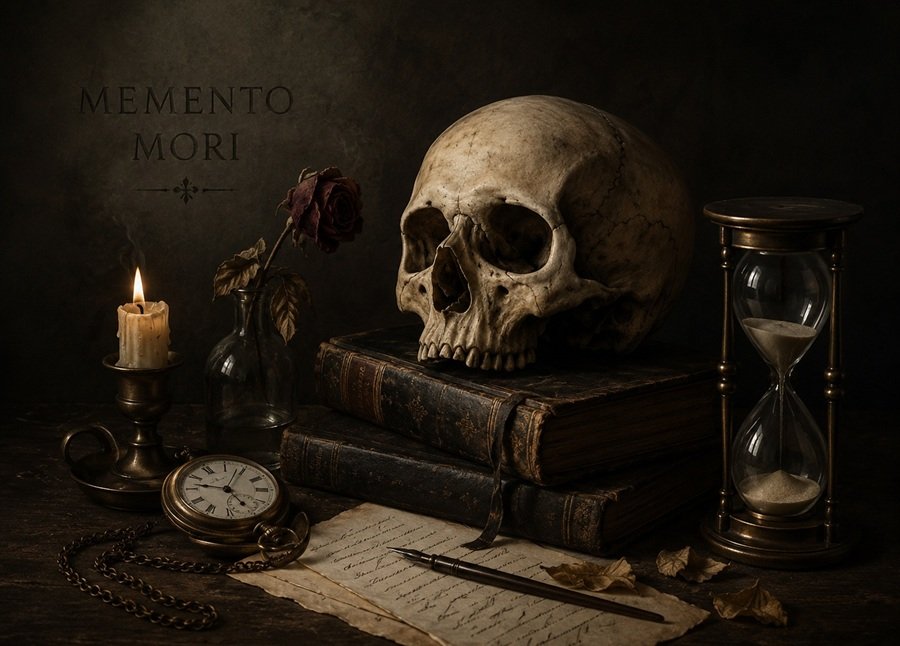
Across two millennia, memento mori has generated a consistent visual vocabulary. These symbols appear in Roman funerary art, Dutch vanitas paintings of the 17th century, Victorian mourning jewelry, and contemporary tattoo culture.
| Symbol | Meaning | Historical Example |
|---|---|---|
| Skull | Direct reminder of death and bodily decay | Hamlet with Yorick’s skull (Shakespeare, 1600); Caravaggio’s St. Jerome Writing (1606) |
| Hourglass | Time is finite and running out | Ubiquitous in Dutch vanitas still life; common in 17th–18th century tombstone carving |
| Wilting or cut flower | Beauty and life are transient | Jan van Huysum’s flower paintings; Ecclesiastes 1:2 (“Vanity of vanities”) |
| Extinguished candle | The flame of life snuffed out | Pieter Claesz, Vanitas Still Life (1630); common in Baroque funerary painting |
| Mirror | Self-reflection; the vanity of appearances | Hans Holbein the Younger’s The Ambassadors (1533) includes a distorted skull |
| Raven or crow | Omen of death across multiple cultures | Edgar Allan Poe’s The Raven; Celtic and Norse mythology |
| Butterfly | The soul departing the body | Ancient Greek psyche symbolism; early Christian catacomb art |
The vanitas painting — a genre perfected in Leiden and Haarlem in the Dutch Golden Age — assembled several of these symbols into a single composition. A skull rests beside a half-eaten meal, an overturned wine goblet, an open watch. The message was a philosophical argument in pigment: earthly pleasure is real, and it ends.
Memento Mori vs. Memento Vivere
The contrast between these two phrases is frequently misunderstood online, so it is worth being precise.
Memento mori — “Remember you must die” — is the original and attested ancient phrase.
Memento vivere — “Remember to live” — is a later, largely modern coinage. It does not appear with frequency in classical or medieval sources. It gained popularity in the 20th century as a counterweight, most associated with the idea that awareness of death should produce engagement with life rather than retreat from it.
The distinction matters philosophically. Memento mori and memento vivere are not opposites — they are, in the Stoic reading, the same instruction from two angles:
- Memento mori: finite time means you should not waste it.
- Memento vivere: finite time means you should not fear to use it.
The error is treating memento mori as nihilistic — as if “you will die” were a reason for despair. The Stoic tradition, consistently, read it the opposite way. Death gives weight to choice. It is why carpe diem (Horace, 23 BCE) and memento mori are complementary rather than contradictory. Seize the day because the day is finite. Remember death because life, consequently, is not to be squandered.
Memento Mori Tattoo: 7 Most Popular Designs in 2026
The memento mori tattoo has become one of the most searched tattoo concepts of the past three years — and the reasons are worth understanding rather than dismissing. For many people, particularly in the 18–34 demographic, a memento mori tattoo is a philosophical statement worn permanently on the body. It is a commitment, in ink, to a way of seeing.
Here are the seven designs dominating searches and studios in 2026:
1. Minimalist Latin Script
The phrase itself, in a clean serif or Roman typeface, placed on the inner forearm, collarbone, or ribcage. Often accompanied by a small em dash or period. Understated, legible, and the most literally faithful to the tradition.
2. Skull with Blooming Flowers
A skull partially obscured or emerging from flowers — roses, peonies, wildflowers. The juxtaposition of death and growth is visually striking and philosophically coherent: both are true simultaneously.
3. Hourglass (Forearm or Shin)
An anatomically rendered or geometric hourglass, often with fine-line detail, sometimes with sand still falling. Forearm and shin placements are most common. Some versions include a cracked glass to suggest urgency.
4. Skull + Hourglass Combination
The two primary memento mori symbols combined — sometimes rendered in a woodcut or engraving style that references historical vanitas prints directly.
5. Memento Mori Compass or Clock Face
A clock or compass face where the numbers are replaced, or where a skull serves as the dial center — pointing to the idea that time and direction are both oriented toward death.
6. Raven with Latin Text
A raven perched on a branch or skull, paired with the phrase. More ornate than minimalist script; typically done in black and grey realism or neo-traditional style.
7. Fine-Line Vanitas Still Life
A detailed still life composition — skull, hourglass, candle, flower — rendered in fine-line black ink, sometimes on the thigh or upper arm. References 17th-century Dutch painting directly and tends to attract people who know the history behind it.
A note on placement: inner forearm placements signal that the wearer wants to see it daily — consistent with the Stoic purpose of the phrase as a regular reminder rather than a one-time meditation.
How to Practice Memento Mori Today
The Stoics did not treat memento mori as a passive reminder. It was an askesis — a practice, a discipline with specific exercises. Here are three drawn directly from ancient sources and adapted for contemporary life:
Exercise 1: The Evening Review (Marcus Aurelius)
Each evening, before sleep, review the day. Ask: Did I act according to my values? Did I treat the people around me as they deserve? Did I waste hours that will not return? Do not catastrophize failure — simply note it and resolve. This is what Marcus means by “balance life’s books each day.” The review works because death is the ultimate auditor; practicing for that audit daily makes the final reckoning less surprising.
Exercise 2: Negative Visualization (Seneca / Epictetus)
Take something you value — a relationship, your health, your work — and spend five minutes genuinely imagining its loss. Not to induce grief, but to restore appreciation. Seneca writes: “He robs present ills of their power who has perceived them to come.” We see this in modern psychological research too: studies on “savoring” show that anticipated loss increases present enjoyment. The Stoics arrived at this through philosophical reasoning; positive psychology confirmed it empirically.
Exercise 3: The Memento Mori Object
Keep a physical object — a skull paperweight, a watch, a coin inscribed with the phrase — somewhere you encounter it daily. The Roman tradition of the slave’s whisper has no direct modern equivalent, but an object on your desk functions similarly: a small, recurring interruption that asks Is this what you would choose to spend a finite day on?
These are not morbid exercises. They are, if anything, the opposite — methods for generating presence, gratitude, and deliberate choice in a culture that works very hard to suppress awareness of mortality.
Why Gen Z Is Searching Memento Mori in 2026
A genuine trend deserves a genuine explanation, not a trend-chaser’s guess.
The generation that grew up during a global pandemic, a mental health crisis explicitly named by medical institutions, and an accelerating climate emergency has had mortality placed at the center of cultural conversation in a way no previous generation experienced in peacetime. When death is in the foreground rather than the background, the old philosophical traditions that address it directly stop feeling archaic and start feeling useful.
Stoicism’s broader revival — documented since approximately 2012 and accelerating through communities on Reddit, YouTube, and podcasting — created the infrastructure. Ryan Holiday’s The Obstacle Is the Way (2014) and Ego Is the Enemy (2016) brought Marcus Aurelius to an audience that had never taken a Latin class. The Daily Stoic, as a platform, introduced memento mori coins and objects to an audience of millions.
The tattoo trend follows the philosophical trend. It is the generation that finds institutional religion less compelling choosing to mark their bodies instead of their walls with moral commitments. The permanence of a tattoo mirrors the permanence of the fact it commemorates.
Frequently Asked Questions
What is a memento mori?
A memento mori is any object, image, phrase, or practice intended to remind a person of their own mortality. The term comes from the Latin for “Remember, you must die.” Historically, memento mori have included painted skulls, hourglasses, wilting flowers, funerary monuments, and — in Roman military tradition — a slave whose sole function was to whisper the reminder to a triumphant general.
What does memento mori mean?
Memento mori means “Remember you must die” in Latin. It is an imperative sentence: memento is the imperative form of meminisse (“to remember”), and mori is the infinitive of the verb “to die.” In contemporary usage, the phrase also refers to the entire philosophical and artistic tradition built around that reminder.
Is memento mori religious?
It has been both religious and secular throughout its history. Roman use was civic and philosophical rather than religious in the Christian sense. The medieval tradition was explicitly Christian, concerned with preparing the soul for judgment. Renaissance and Baroque vanitas painting blended religious and secular concerns. Contemporary Stoic and tattoo culture is largely secular. The concept does not require any specific theological commitment.
What is the opposite of memento mori?
There is no true opposite in the classical tradition — the concept is not structured that way. Memento vivere (“Remember to live”) is sometimes positioned as a counterpart, though it is a modern coinage. Carpe diem is often mentioned in this context, but it is better understood as memento mori’s complement: seize the day because you will die. Both phrases emerge from the same philosophical logic.
Why do people get memento mori tattoos?
The reasons are varied but generally sincere. Most people who get a memento mori tattoo describe it as a commitment to presence and purposeful living — a permanent reminder not to defer what matters. Some are motivated by personal loss; others by Stoic philosophy; others by the aesthetic tradition of skull and vanitas imagery. The tattoo functions as the modern equivalent of the Roman slave’s whisper: a built-in, recurring prompt to consider whether you are spending your finite time as you actually intend.
Further Reading and Primary Sources
- Marcus Aurelius, Meditations — Gregory Hays translation (Modern Library, 2002) is the most readable English version
- Seneca, Letters from a Stoic (Epistulae Morales ad Lucilium) — Robin Campbell translation (Penguin Classics)
- Ars Moriendi (c. 1415) — available in facsimile through the British Library digital collections
- Stanford Encyclopedia of Philosophy — Stoicism
- The Metropolitan Museum of Art — Vanitas Still Life
- Internet Classics Archive — Marcus Aurelius Meditations
Must Read: Malia Obama in 2026: The Name Change, the Hollywood Hustle, and What She’s Really Up To Now
