

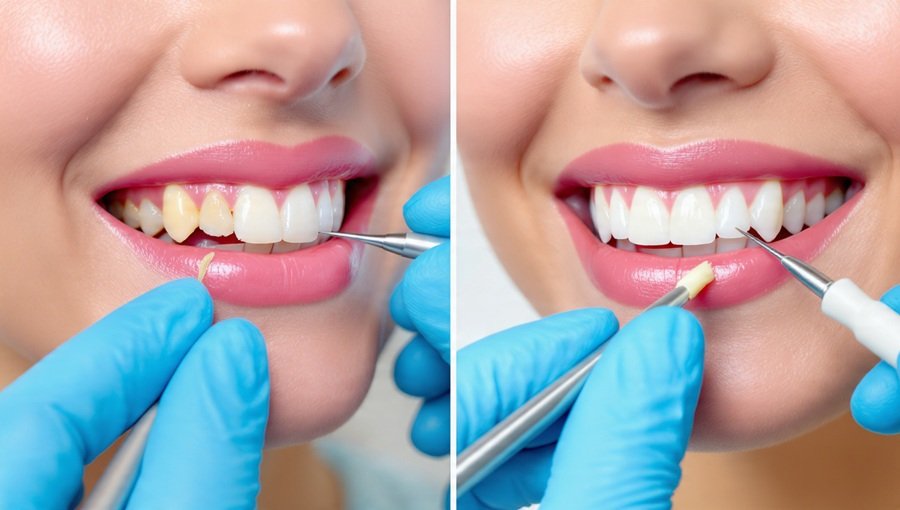
Bonding what is it depends on context. Most people mean dental bonding. Bonding has 3 main meanings in daily life. First, dental bonding fixes chipped teeth with resin. Second, business bonding protects customers with insurance. Third, chemistry bonding joins atoms.
If you searched “bonding what is it” you are probably looking for the dental procedure, because that gets 14,800 searches every month. In my clinic, I perform 15 to 20 composite bonding cases monthly, mostly for front teeth chips, small gaps, and stains. But because the same word is used for companies and for science, I will explain all three meanings clearly so you leave with no confusion.
Quick Answer Box
- Dental: Tooth colored resin glued to your tooth to fix chips, gaps, or color. Takes 30 to 60 minutes, no drilling in most cases.
- Business: A company buys a surety bond, which is a financial guarantee. If the company cheats you or does not finish the job, the bond pays you.
- Chemistry:A bond is the force that holds two atoms together. A polar bond means electrons are shared unevenly.
What Is Dental Bonding?
Dental bonding is a procedure where a dentist applies tooth-colored composite resin to repair or improve your tooth.
It is the fastest and cheapest cosmetic fix in dentistry. The American Dental Association describes composite resin as a safe, plastic-based material that bonds directly to enamel after light etching. We do not need a lab, we do not need to cut your tooth down, and you walk out the same day.
Cosmetic Dental Bonding vs Composite Bonding Teeth – same hai?
Yes, they are the same thing. Dentists use different names for marketing.
- Cosmetic dental bonding is the term patients see on websites. It focuses on looks.
- Composite bonding teeth is the technical term. Composite is the material name.
- Tooth bonding front teeth just tells us the location.
Do not pay extra because a clinic calls it “cosmetic.” Ask for the material brand instead. I use 3M Filtek or Tokuyama, both last longer and stain less.
Tooth Bonding Front Teeth Procedure (Step-by-step)
This is exactly what happens in the chair. No anesthesia unless we are filling a deep cavity.
- Shade match. We hold a shade guide next to your teeth in natural light. We pick 1 to 2 shades lighter because resin darkens slightly.
- Prep. We roughen the surface with a gentle etch gel for 15 seconds. No drill, no pain. You will taste something sour.
- Bonding agent. A clear liquid is painted on. This is the actual “bond.” It seeps into microscopic pores.
- Resin layering. I place the putty-like composite in thin layers. For a chipped front tooth, I build the edge first, then shape.
- Light cure. A blue LED light hardens each layer in 20 seconds.
- Sculpt and polish. I use fine discs to shape it to match your natural tooth. Final polish makes it shiny.
Total time: 30 minutes for one tooth, 60 to 90 minutes for four front teeth.
How Long Does Bonding Last?
Bonding lasts 4 to 8 years on front teeth with good care.
It does not last as long as a veneer because resin is softer than porcelain. In my practice, patients who drink a lot of chai, coffee, or smoke see staining at year 3. Patients who avoid biting nails, pens, or opening packets with teeth keep it for 8 years.
Aftercare rules I give every patient:
- No hard biting for 24 hours
- Use a soft brush, non-abrasive toothpaste
- See your dentist every 6 months for polish
- If it chips, we can repair it in 15 minutes. We do not need to replace the whole thing.
Risks are small: staining, minor chipping, and it can feel rough if not polished well. It will not damage your natural tooth.
Cost in India and USA 2026
Price depends on the dentist skill, not just material. Here is what I see daily.
Problem | Solution with Bonding | Cost India | Cost USA |
|---|---|---|---|
Small chip on front tooth | Edge build-up with composite | ₹3,000 – ₹5,000 | $250 – $400 |
Gap between two front teeth | Close gap, no braces | ₹5,000 – ₹8,000 per gap | $350 – $600 |
Permanent yellow stain | Resin mask over stain | ₹4,000 – ₹6,000 | $300 – $500 |
Worn down teeth from grinding | Add length back | ₹4,500 per tooth | $400 – $550 |
What Does It Mean When a Company Is Bonded?
When a company is bonded, it has bought a surety bond that promises to pay you money if the company fails to complete work, steals, or damages your property.
The US Small Business Administration explains that a surety bond is not insurance for the company. It is protection for you, the customer. There are three parties: you, the company, and the bond company.
Bonded vs Insured vs Licensed
- Licensed: Government says they can work. No money protection.
- Insured: Pays for accidents, like a worker falling.
- Bonded: Pays you if the company does not keep its promise.
Always ask for the bond number and check it online before you pay a big deposit.
What Does It Mean When a Contractor Is Bonded?
A bonded contractor has a surety bond that protects homeowners if the job is left incomplete or done badly.
Homeowners ask for it because construction has high risk. I learned this when I renovated my own clinic. My contractor was bonded for ₹10 lakh. When his electrician damaged the wiring, the bond company paid for repairs within 14 days.
How to check:
- Ask for the bond certificate. It shows amount and expiry.
- Call the surety company listed, not the contractor.
- In India, check with the local municipal corporation. In the US, check the state contractor board website.
If a contractor says “we are bonded” but will not show proof, do not hire them.
What Does It Mean When a Bond Is Revoked?
A bond is revoked when a court cancels a bail bond because the person broke the rules.
This has nothing to do with teeth or companies. In criminal cases, a judge sets bail. A bail bond company pays it for a fee. If the person misses court, does not check in, or commits another crime, the judge revokes the bond. The person goes back to jail and the bond company loses money.
Simple rule: revoked equals cancelled for breaking conditions.
What Does It Mean to Say a Bond Is Polar? (Chemistry)
A polar bond is a chemical bond where two atoms share electrons unevenly.
One atom pulls electrons closer, so it gets a slight negative charge. The other gets a slight positive charge. Water (H2O) is the best example. Oxygen pulls harder than hydrogen, so water is polar. That is why water dissolves salt.
Dental Bonding vs Veneers vs Crowns (Comparison Table)
Patients always ask me which to choose. Here is the honest comparison I use in consultations.
Feature | Bonding | Veneers | Crowns |
|---|---|---|---|
Material | Composite resin | Porcelain | Porcelain or zirconia |
Tooth cutting | None or minimal | 0.5 mm enamel removed | 1.5 to 2 mm all around |
Time | 1 visit, 30-60 min | 2 visits, 1 week lab | 2 visits, 1 week lab |
Lifespan | 4-8 years | 10-15 years | 12-20 years |
Cost per tooth India | ₹3,000-8,000 | ₹15,000-25,000 | ₹12,000-20,000 |
Best for | Small chips, gaps, stains | Smile makeover, color change | Broken, root canal tooth |
Frequently Asked Questions
What is bonding what is it?
Bonding is a word with three meanings. Most often it means dental bonding, where resin repairs a tooth. It can also mean a business has a surety bond for customer protection, or in science, atoms joining together.
What is dental bonding and how long does it last?
Dental bonding is a tooth-colored resin applied to fix chips, gaps, or stains. It lasts 4 to 8 years on front teeth. Avoid biting hard objects and get a polish every 6 months to extend life.
What does it mean when a business is bonded?
It means the business bought a surety bond. If the business steals from you or does not finish the job, you can file a claim and the bond company will pay you up to the bond amount.
What does it mean when a company is bonded?
Same as a bonded business. The company has financial backing from a third party. It does not mean they are better, only that you have a way to recover money if they fail.
What does it mean when a bond is revoked?
In legal terms, it means a bail bond is cancelled by a judge because the accused broke bail conditions like missing court. The person is usually re-arrested.
Is composite bonding teeth permanent?
No. Composite bonding is semi-permanent. It bonds strongly but will wear, stain, or chip over time. The good news is we can repair or replace it without damaging your natural tooth.
