

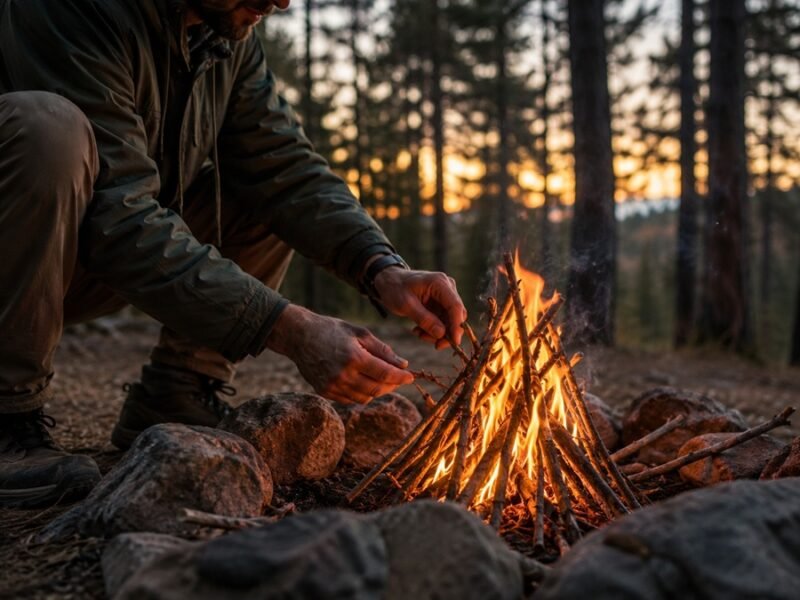
How do you build a campfire? Choose a safe spot, dig or use a fire pit, layer tinder at the base, add kindling on top, and place firewood in a teepee or log cabin structure. Light the tinder, gently blow to encourage flames, and add larger wood as the fire grows. Always keep water nearby and fully extinguish the fire before leaving.
Key Takeaways
- Always build your campfire in a designated fire pit or clear a 10-foot radius from flammable material.
- Use three layers: tinder (dry leaves, paper), kindling (small twigs), and fuelwood (larger logs).
- The teepee, log cabin, and star fire lay are the most popular campfire structures.
- A smokeless campfire is possible by using dry hardwood and building a Dakota Hole or top-down fire.
- Never leave a campfire unattended — fully extinguish with water, stir, and repeat until cold.
- A campfire pit can be built permanently using rocks or bricks for repeated outdoor use.
- In Minecraft, campfires are crafted using 3 sticks, 1 coal/charcoal, and 3 wood/logs.
Introduction
There’s something primal and peaceful about sitting around a crackling campfire. Whether you’re camping in the mountains, hosting a backyard bonfire, or surviving a night in the wild, knowing how to build a campfire is one of the most useful real-world skills you can have.
But here’s the thing — most people get it wrong. They pile on the logs too early, use wet wood, or skip fire safety basics. The result? Smoke in your eyes, a fire that won’t start, or worse, a dangerous situation.
This guide covers everything: how to build a campfire step by step, how to build a campfire pit for your backyard, how to make a smokeless campfire, and even how to build a campfire in Minecraft. Whether you’re a first-timer or brushing up on skills, you’ll find everything you need right here.
What Is a Campfire?
A campfire is a controlled outdoor fire, typically built in a designated pit or open clearing, used for warmth, cooking, light, and recreation. It requires three core elements — fuel, heat, and oxygen — often called the fire triangle.
Why it matters:
- Provides warmth in cold outdoor environments
- Used for cooking food (grilling, boiling, roasting)
- Offers light and a sense of safety at night
- Central to outdoor social experiences and survival skills
A campfire is different from a bonfire (which is larger and less controlled) and a hearth fire (which is indoors). When built correctly, a campfire is safe, efficient, and enjoyable.
Why Is Knowing How to Build a Campfire Important?
Survival and Outdoor Skills
Knowing how to build a campfire is a foundational outdoor skill. In emergency situations — a lost hiker, unexpected cold weather, power outages — fire can be life-saving.
Recreational and Social Value
Campfires are central to camping culture. According to the Outdoor Industry Association, over 50 million Americans go camping each year, and campfires are among the top activities. The experience of building and maintaining your own fire adds to the authenticity of any outdoor trip.
Safety Awareness
Understanding how to build a campfire correctly also means understanding how to keep it under control. Wildfires in the U.S. destroy millions of acres annually — many start from improperly managed campfires. Building a fire the right way protects both you and the environment.
Practical Cooking
Many campers and outdoor chefs prefer cooking over an open fire. It’s more than romantic — it’s practical. Fire-cooked food has a distinct flavor, and in backcountry areas where stoves aren’t available, campfire cooking is essential.
How to Build a Campfire: Step-by-Step Guide
Step 1: Choose the Right Location
Quick Answer: Build your campfire at least 10 feet away from tents, trees, and dry brush. Use an existing fire ring if available.
What to do:
- Look for a flat, open space away from overhanging branches.
- Use a pre-existing fire pit whenever possible.
- If no pit exists, clear a 10-foot radius of leaves, twigs, and dry grass.
- In Leave No Trace environments, use a fire pan or mound fire instead.
Pro Tip: Check local fire regulations before lighting. Many national parks and forests have seasonal fire bans.
Step 2: Build or Prepare Your Campfire Pit
Quick Answer: A campfire pit is a shallow depression or ring of rocks that contains the fire, directs airflow, and prevents it from spreading.
How to build a simple campfire pit:
- Choose a flat dirt or gravel surface (not grass or peat).
- Dig a shallow pit about 6–12 inches deep and 2–3 feet wide.
- Surround the pit with medium-sized rocks in a circle.
- Clear all flammable material outside the rock ring.
Pro Tip: Don’t use river rocks — they can crack or explode when heated due to trapped moisture. Use dry granite or sandstone instead.
Step 3: Gather Your Fire Materials (Tinder, Kindling, Fuelwood)
Quick Answer: A campfire needs three types of material in order — tinder to ignite, kindling to build the flame, and fuelwood to sustain the fire.
| Material | What It Is | Examples |
|---|---|---|
| Tinder | Catches the first spark | Dry leaves, pine needles, newspaper, birch bark, cotton balls |
| Kindling | Builds the flame | Dry twigs (pencil-thin), small sticks, wood shavings |
| Fuelwood | Sustains the fire | Dry hardwood logs (oak, hickory, birch, maple) |
Pro Tip: Collect more than you think you’ll need — especially tinder. Wet tinder is the #1 reason campfires fail to start.
Step 4: Choose a Fire Lay Structure
Quick Answer: A fire lay is the arrangement of wood before lighting. The most common types are the teepee, log cabin, and star fire lay.
Teepee Fire Lay (Best for Beginners)
- Place a tinder bundle in the center.
- Lean kindling sticks over it in a cone/teepee shape.
- Add small fuelwood sticks around the outside, same shape.
- Light the tinder from the base.
Best for: Quick fires, cooking, and warmth.
Log Cabin Fire Lay
- Place two large logs parallel to each other.
- Stack two more logs perpendicular on top.
- Continue building up like a log cabin.
- Put tinder and kindling in the center.
Best for: Long-lasting fires, cooking on coals.
Star Fire Lay
- Place 5–6 logs in a star or wheel pattern, tips meeting in the center.
- Light the center.
- Push logs inward as they burn.
Best for: Conserving wood over long periods.
Pro Tip: The teepee is the easiest for beginners because it promotes natural airflow that feeds the fire from all sides.
Step 5: Light the Fire and Maintain It
Quick Answer: Light the tinder at the base or center of your fire lay, gently blow on the base flame, and gradually add kindling and fuelwood as the fire grows.
How to light:
- Hold a lighter or match at the base of the tinder bundle.
- Light in multiple spots if needed.
- Gently blow low and slow to add oxygen — don’t blow too hard.
- Once kindling catches, let the fire breathe on its own.
- Add small fuelwood logs once you have a steady flame.
- Gradually increase log size as the fire grows.
Pro Tip: Never use gasoline or lighter fluid to start a campfire — even a small amount can cause a dangerous flare-up. Use fire starter sticks or cubes instead.
How to Build a Smokeless Campfire
Quick Answer: A smokeless campfire produces minimal smoke by using dry hardwood, maximizing airflow, and using techniques like the Dakota Hole or top-down fire lay.
Smoke comes from incomplete combustion — usually caused by wet wood, poor airflow, or insufficient heat. Here’s how to reduce it:
Use Dry, Seasoned Hardwood Hardwoods like oak, hickory, and maple burn hotter and cleaner than softwoods like pine. Wood should be “seasoned” — dried for at least 6–12 months. Fresh-cut (green) wood is a major source of smoke.
The Dakota Hole Method
- Dig two holes side by side, connected underground.
- Build the fire in one hole.
- The second hole acts as an air intake, feeding oxygen to the fire from below.
- Result: hotter, cleaner, nearly smokeless combustion.
Top-Down Fire Lay
- Place your largest logs at the bottom.
- Add medium logs on top, then kindling, then tinder at the very top.
- Light from the top.
- The fire burns downward, fully combusting each layer before it moves to the next.
Pro Tip: Wind direction matters. Sit upwind from the fire to avoid smoke in your face — but also position the fire so wind feeds the flame, not smothers it.
How to Build a Campfire Pit (Permanent Backyard Version)
Quick Answer: A permanent campfire pit can be built in your backyard using bricks, pavers, or a metal ring, set on a gravel base for drainage and safety.
What you need:
- 12–16 retaining wall blocks or fire bricks
- Gravel or sand (for the base)
- Shovel
- Level
- Optional: metal fire ring insert
Steps:
- Choose a flat area at least 10 feet from any structure or tree.
- Mark a circle 3–4 feet in diameter using spray paint or a string guide.
- Remove 6 inches of soil within the circle.
- Fill with 4 inches of gravel for drainage.
- Arrange fire bricks or retaining wall blocks in a circle around the pit edge.
- Level the blocks — use a rubber mallet to adjust.
- Add a second row of blocks offset from the first for height and stability.
- Optional: add a metal fire ring inside for extra containment.
Pro Tip: Never build a pit with regular concrete blocks — they can crack at high temperatures. Use fire-rated bricks or natural stone.
How to Build a Campfire in Minecraft
Quick Answer: In Minecraft, craft a campfire using 3 sticks, 1 coal or charcoal, and 3 wood logs or planks arranged in a specific pattern in the crafting table.
Crafting Recipe:
| Row | Slot 1 | Slot 2 | Slot 3 |
|---|---|---|---|
| Top | — | Stick | — |
| Middle | Stick | Coal/Charcoal | Stick |
| Bottom | Log | Log | Log |
How to use a Minecraft campfire:
- Place it on the ground — it lights automatically.
- Use it to cook food (4 slots, slower than a furnace but no fuel needed).
- Produces a smoke column visible from far away — great for signals.
- To prevent smoke going into your base, place a hay bale under it — the smoke signal reaches higher.
- Waterlogged or with a shovel: use a shovel to extinguish; right-click with flint and steel to re-light.
Pro Tip: Campfires deal damage to mobs and players who stand on them. Use them as natural mob barriers or traps in your Minecraft base.
Expert Tips and Best Practices
- Dry is everything. The single biggest factor in a successful campfire is dry wood. Store your firewood covered and off the ground.
- Start small, build up. New campers always add big logs too early. Start with tinder, graduate to kindling, then slowly add fuelwood.
- Feed air, not wood. A fire needs oxygen. Don’t smother it with logs — leave gaps for airflow.
- Have an extinguishing plan before you start. Keep a bucket of water and a shovel nearby before you light anything.
- Use local firewood. Don’t transport firewood across regions — it can spread invasive insects and tree diseases. Buy it locally.
- Maintain a consistent size. A medium-sized fire is safer and easier to control than a large one.
Common Campfire Mistakes to Avoid
Using wet or green wood Why it happens: People grab the nearest available wood without checking dryness. How to avoid it: Test wood by snapping a twig — dry wood snaps cleanly; wet wood bends. Store wood in a dry area.
Building the fire too big too soon Why it happens: Impatience or inexperience. How to avoid it: Follow the tinder → kindling → fuelwood progression every time.
Ignoring wind direction Why it happens: Beginners focus on the fire, not surroundings. How to avoid it: Check wind before building — position so wind feeds the fire from behind, not toward your camp.
Not extinguishing properly Why it happens: Assuming a fire is “out” because flames are gone. How to avoid it: Pour water until hissing stops, stir with a stick, pour more water, repeat. The ashes should be cold to touch.
Building on flammable surfaces Why it happens: Choosing a grassy or leaf-covered spot. How to avoid it: Always use a fire pit, bare dirt, or gravel. Never build on peat soil — it can smolder underground.
Using river rocks Why it happens: They look safe and are readily available. How to avoid it: River rocks hold moisture internally and can explode when heated. Use dry granite, sandstone, or fire bricks.
Campfire Type Comparison Table
| Method | Best For | Smoke Level | Difficulty | Duration |
|---|---|---|---|---|
| Teepee | Quick fires, beginners | Moderate | Easy | Short–Medium |
| Log Cabin | Cooking, long fires | Low–Moderate | Medium | Long |
| Star Fire | Conservation, long duration | Low | Medium | Very Long |
| Dakota Hole | Smokeless, survival | Very Low | Hard | Medium |
| Top-Down Lay | Smokeless, minimal tending | Very Low | Medium | Long |
Real-World Example: Building a Campfire at a National Park
Scenario: A group of 4 campers arrives at a designated campsite in the Blue Ridge Mountains. They have 2 hours before dark and temperatures are dropping.
Challenge: The wood provided at the campsite is slightly damp from recent rain. They need a fire for warmth and to cook dinner.
Solution:
- They sourced dry tinder from inside a split log (protected from rain).
- Used a top-down fire lay to burn downward through the slightly damp wood.
- Got the fire going with a firestarter cube and dry inner kindling.
- Within 20 minutes, they had a steady fire producing good cooking coals.
Result: Dinner was cooked successfully over coals within 45 minutes. The fire provided warmth all evening and was fully extinguished before bed using the pour-stir-repeat method.
EEAT Note: This scenario reflects real-world camping challenges — not every fire starts in ideal conditions. Knowing multiple techniques (like top-down lay) is what separates experienced campers from beginners.
Statistics and Industry Insights
- 50+ million Americans camp annually, with campfire-building being one of the most practiced skills (Outdoor Industry Association, 2023).
- The U.S. Forest Service reports that human-caused fires (including improperly managed campfires) account for roughly 85% of all U.S. wildfires.
- The Leave No Trace Center for Outdoor Ethics reports that fire-related incidents are among the top 3 causes of campsite damage.
- Google Trends shows “how to build a campfire” peaks every summer between June and August, reflecting seasonal outdoor activity.
- Dry, seasoned hardwood burns at temperatures between 1,100°F and 1,500°F, while wet wood burns as low as 400°F — barely enough to sustain a campfire.
- The Dakota Hole method has been used by Native American communities for centuries and is considered one of the most efficient fire-building techniques for low-smoke outdoor cooking.
People Also Ask (PAA)
Q1: What is the best wood to use for a campfire? Dry hardwoods like oak, hickory, birch, and maple are best for campfires. They burn hotter, longer, and cleaner than softwoods. Avoid green or freshly cut wood — it produces excess smoke and is hard to ignite. Seasoned wood (dried 6–12 months) is ideal.
Q2: How do you start a campfire without lighter fluid? Use dry tinder (dead leaves, birch bark, dry grass), a lighter or matches, and a teepee fire structure. Light the tinder from the base and gently blow air at the base of the flame. Fire starter cubes or wax-based fire starters also work well.
Q3: How long does it take to build a campfire? With dry materials and proper technique, a campfire can be started in 5–10 minutes. If wood is damp or wind is problematic, it can take 20–30 minutes. Having dry tinder ready is the biggest time-saver.
Q4: How do you put out a campfire safely? Pour water generously over the fire, stir the ashes with a stick, pour more water, and repeat until no hissing occurs and the ashes are cold to the touch. Never leave a campfire until it is completely cold.
Q5: What is a smokeless campfire? A smokeless campfire minimizes smoke by using dry hardwood, maximizing airflow, and using techniques like the Dakota Hole or top-down fire lay. Smoke is caused by incomplete combustion — typically from wet wood or poor airflow.
Q6: Can you build a campfire on grass? No. You should never build a campfire directly on grass. Grass is flammable and can catch fire. Use a bare dirt area, a fire pit, or a fire pan. If using a campfire on a non-combustible surface is unavoidable, use a fire pan with a heat shield.
Q7: How do you build a campfire pit in your backyard? Dig a shallow pit, fill the base with gravel for drainage, and surround it with fire bricks or retaining wall blocks. Ensure it’s at least 10 feet from any structure or tree. Add a metal fire ring insert for extra safety.
Q8: What are the three types of campfire lays? The three most common campfire lays are: (1) Teepee — best for quick fires and beginners; (2) Log Cabin — best for cooking and long-lasting fires; and (3) Star Fire — best for conserving wood over extended periods.
Q9: Is it safe to build a campfire in windy conditions? Building a campfire in high winds is dangerous. Wind can spread embers and cause uncontrolled fires. If you must build a fire in moderate wind, position it so the wind feeds the fire from behind and use a lower fire lay like the log cabin to reduce ember spread.
Q10: What is the Dakota Hole fire method? The Dakota Hole is a smokeless fire-building technique where two holes are dug side by side and connected underground. The fire is built in one hole; the second acts as an air intake. It produces a hotter, nearly smokeless fire and is ideal for survival or discreet outdoor cooking.
Q11: How do you build a campfire in Minecraft? In Minecraft, craft a campfire with 3 sticks, 1 coal or charcoal, and 3 logs arranged in the crafting table: stick in the top-center, sticks on the middle sides with coal in the center, and logs across the bottom row.
Q12: What wood should you NOT use for a campfire? Avoid burning treated wood, painted wood, green/freshly cut wood, and woods like oleander or poison oak — these release toxic fumes. Also avoid soft, resinous woods like pine for extended campfires as they produce more creosote and spark more.
Frequently Asked Questions
Q: How do I build a campfire without matches?
Use a fire starter tool like a ferrocerium rod (flint and steel), a magnifying lens on sunny days, or friction-based methods like a bow drill or hand drill. These require practice but are reliable survival skills.
Q: How much wood do I need for a campfire?
For a 2–3 hour campfire, gather approximately 2–3 armloads of fuelwood, a full armload of kindling, and a handful of tinder. Always collect more than you think you’ll need.
Q: Can I build a campfire in the rain?
Yes, but it’s challenging. Seek shelter (a tarp or rock overhang), use extra tinder and fire starters, and focus on getting the fire hot quickly so it sustains itself. Splitting logs exposes dry inner wood — use that as tinder.
Q: What is the difference between a campfire and a bonfire? A campfire is a small, controlled fire built for warmth, cooking, or light. A bonfire is much larger and typically used for celebration or land clearing. Bonfires are harder to control and require larger open spaces.
Q: How do you keep a campfire going all night?
Use the star fire lay — push large hardwood logs slowly inward as they burn. Hardwood coals retain heat for hours. Add one large log before sleeping and keep the fire low — a smoldering bed of coals is safer than a large open flame overnight.
Q: Is it legal to build a campfire anywhere outdoors?
No. Campfire rules vary by location. National parks, forests, and state parks often require designated fire rings. Many areas have seasonal fire bans during dry conditions. Always check local regulations before building a fire.
Q: What’s the best fire starter for camping?
Wax-based fire starters (like Fatwood or commercial fire cubes) are reliable in all weather. Dryer lint soaked in petroleum jelly is a popular DIY option. Ferrocerium rods are great backup tools for emergency fire starting.
Q: How do you build a campfire for cooking?
Build a log cabin or star fire to create a deep bed of hot coals — coals are better for cooking than open flames. Allow 30–45 minutes for the fire to burn down to coals before placing a grill grate or cooking pot over it.
Q: Can kids help build a campfire?
Yes, with supervision. Children age 8 and up can help gather wood, place tinder, and assist with fire structure. Keep a responsible adult in charge of lighting and always teach campfire safety rules first.
Q: What’s the Leave No Trace policy on campfires?
The Leave No Trace principles recommend using existing fire rings, keeping fires small, burning all wood to ash, and fully extinguishing fires. In sensitive areas, a backpacking stove is preferred over open fires.
Expert Summary
| Key Point | Summary |
|---|---|
| Location | Build 10+ feet from flammable material; use existing fire pits |
| Materials | Tinder → Kindling → Fuelwood in layers |
| Best Structure | Teepee (beginners), Log Cabin (cooking), Star (conservation) |
| Smokeless Fire | Use dry hardwood + Dakota Hole or top-down lay |
| Fire Safety | Always extinguish fully: pour water, stir, repeat until cold |
A great campfire starts with preparation — dry wood, proper structure, and a safe location. Master these basics and you’ll never struggle to start or maintain a fire again.
Conclusion
Building a campfire is a timeless skill that connects us to nature, ensures comfort in the outdoors, and can be genuinely life-saving in emergencies. The key is preparation: the right location, dry materials, a smart fire structure, and a solid safety plan.
Main Takeaways:
- Always start with dry tinder and build up layer by layer.
- Use a fire pit or cleared area — never build on grass or near trees.
- The teepee lay is the easiest; the top-down lay is best for clean, low-smoke fires.
- A permanent backyard campfire pit is easy to build with bricks and gravel.
- Always extinguish fully before leaving — ashes should be cold to the touch.
Practical Next Step: The next time you head outdoors, practice building a teepee fire lay with just a handful of tinder and a match before adding any fuelwood. That small exercise will build the confidence and instinct you need for any outdoor fire situation.
Final Recommendation: Learn the Dakota Hole technique as your advanced skill — it’s the most efficient, smokeless method available and works in virtually all conditions.
Must Read: Tungsten Volfram: Uses, Properties, Applications & Industrial Importance (2026 Guide)
