
Digital transformation has a dirty secret. Despite trillions of dollars invested globally each year, research consistently shows that 70–95% of digital transformations fail to meet their original objectives. Not because of bad technology. Not because of insufficient budgets. And certainly not because of a lack of ambition.
They fail because of people.
More specifically, they fail because organizations lack the tools to understand their own people—their real capabilities, their actual readiness, and the systemic gaps that sit quietly beneath the surface until a multi-million-dollar initiative unravels. That’s the problem I’ve spent 30 years watching play out across industries, geographies, and company sizes. And that’s precisely why I’m building Capabilisense.
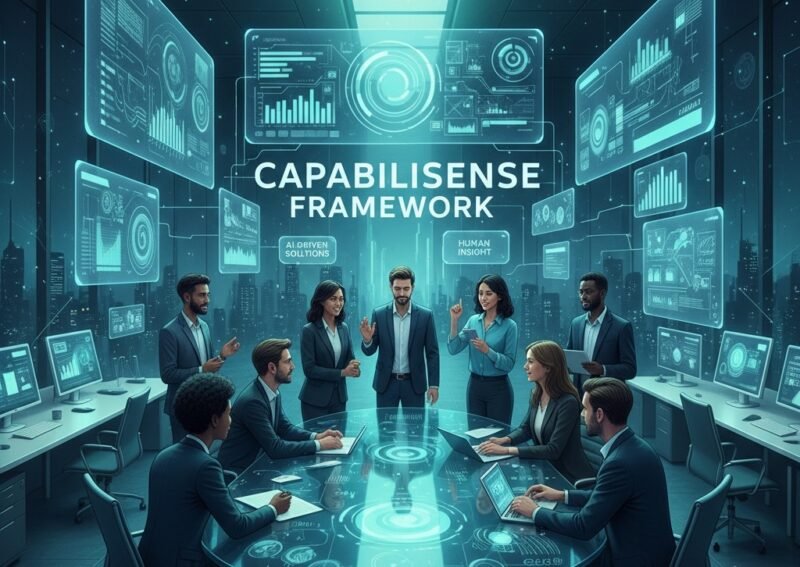
This article explores the thinking, frustration, and hard-earned pattern recognition behind Capabilisense—an AI-powered capability intelligence platform designed to close what I call the Human Gap in digital transformation. If you’ve ever watched a brilliant strategy collapse under the weight of execution reality, read on.
The ‘Aha’ Moment: Why I’m Building Capabilisense Now
After decades of consulting work across large-scale transformation programs, a pattern became impossible to ignore. Organizations would arrive with talented people, seasoned leadership, and generous investment—all the ingredients that should guarantee success. Yet transformation after transformation stalled, fragmented, or quietly faded into a trail of expensive lessons learned.
The common denominator was never the technology. It was Sense-making—or the lack of it.
Sense-making is the organizational capacity to interpret information, make meaning out of complexity, and translate insight into coherent action. Without it, even the most capable teams operate in silos. They misread signals. They solve the wrong problems with impressive efficiency. And they remain perpetually surprised by predictable failures.
The “aha” moment wasn’t dramatic. It came gradually, through accumulated evidence—a capability assessment that missed critical behavioral drivers here, a transformation roadmap disconnected from ground-level reality there. What became clear was that the field was awash in tools that measured what organizations had, but almost none that helped them understand what those things actually meant in context.
That gap—between inventory and insight—is the founding problem Capabilisense is built to solve.
What is Capabilisense? Beyond the Buzzwords
The name is deliberate. Capabilisense blends two ideas: Capability—the skills, knowledge, and organizational capacity an enterprise possesses—and Sense-making—the intelligence to interpret those capabilities within a real, dynamic context.
Most capability frameworks stop at measurement. They produce a score, a maturity level, or a competency map. Capabilisense goes further. It asks: What do these capabilities actually mean for this organization, facing these specific challenges, right now?
At the core of the platform is Venus AI—a proprietary AI engine designed to analyze unstructured documents. Meeting notes, project post-mortems, strategy decks, employee feedback, and leadership communications. The kinds of documents that contain the real story of an organization, not the sanitized version that surfaces in formal surveys.
Venus AI detects patterns, tensions, and capability signals buried within this unstructured data. It surfaces insights that traditional assessments routinely miss—not because those assessments are poorly designed, but because they rely on what people say rather than what the evidence shows.
This distinction is the heartbeat of the entire Capabilisense framework.
The 3 Core Principles of Capabilisense
The platform is built on three foundational principles that collectively reframe how organizations think about Capability Maturity and transformation readiness.
| Principle | Description |
| Contextual Understanding | Skills and capabilities are evaluated not in isolation, but against the specific challenges and strategic objectives the organization is navigating. A strength in one context can be a liability in another. |
| Sensing Over Doing | Before action, there must be reflection. Capabilisense equips leaders with tools for structured reflection and evidence-based feedback interpretation—replacing gut instinct with grounded insight. |
| Systemic Influence | Individual behavior doesn’t occur in a vacuum. People are shaped by the systems, incentives, and cultural norms surrounding them. Capabilisense maps these systemic forces to understand why people behave as they do—not just what they do. |
These principles don’t just inform the product. They challenge the dominant logic of most transformation programs, which treat capability as a fixed attribute rather than a dynamic, context-dependent phenomenon.
How Capabilisense Solves the ‘Human Gap’
The Human Gap is the distance between what an organization believes about its capabilities and what the evidence actually reveals. It’s the space where transformation programs go to die.
Traditional approaches to closing this gap rely heavily on opinion. Stakeholder interviews. Executive workshops. Pulse surveys. These methods are valuable—but they’re inherently subjective. They capture perception, not reality. And perception, filtered through organizational politics, self-preservation instincts, and confirmation bias, is a deeply unreliable guide.
Capabilisense shifts the conversation from opinion-based discussion to evidence-backed clarity.
By analyzing the unstructured documentary record of how an organization actually operates—not how it describes itself in a board presentation—the platform produces a living, continuously updated picture of capability health. Leaders stop debating what they think is true and start responding to what the data shows.
The practical impact is significant. Transformation programs gain earlier warning of capability gaps. Resource allocation improves. Interventions become more targeted. And the costly cycle of launching initiatives without adequate organizational readiness begins to break.
This shift—from assumption to evidence—represents a meaningful upgrade in how enterprises approach AI-driven assessment and digital transformation failure prevention.
From Building a Product to Being the Product
There’s a dimension to this story that goes beyond the professional.
Building Capabilisense hasn’t just been an exercise in product development. It’s been a process of applying the methodology to myself. The same principles of contextual understanding, honest sense-making, and systemic awareness that the platform brings to organizations—I’ve had to bring to my own professional realignment.
Leaving the security of established consulting structures to build something new is a capability challenge in its own right. It requires confronting uncomfortable questions about what you’re actually good at, where your thinking is genuinely novel, and which of your deeply held assumptions deserve to be interrogated.
In many ways, the founder’s journey is the Capabilisense methodology in action. The platform reflects hard-won insight, not just intellectual theory. The battle scars are real—and they’re embedded in every design decision the product makes.
That personal dimension matters. Because organizations are made of people who are navigating the same tension between what they believe about themselves and what the evidence reveals. Capabilisense was built by someone who has lived that tension from both sides of the table.
Capabilisense MVP vs. Traditional Methods
The difference between the Capabilisense approach and conventional capability assessment becomes clear when placed side by side.
| Feature | Traditional Assessment | Capabilisense AI |
| Data Source | Interviews & Surveys (Subjective) | Unstructured Documents (Objective) |
| Speed | Weeks to Months | Hours to Days |
| Output | Static PDF or Slide Deck | Living, AI-Driven Roadmap |
| Bias Risk | High (Social desirability, politics) | Low (Evidence-based signals) |
| Contextual Depth | Generalized frameworks | Challenge-specific interpretation |
| Scalability | Limited by consultant bandwidth | Scales with data volume |
Traditional methods aren’t without merit. They’ve produced genuine value for decades. But the pace of change in today’s operating environment has exposed their limitations. Organizations can’t afford to wait months for a capability diagnosis that’s already outdated by the time it’s delivered. They need insight that moves at the speed of the business.
That’s what the Capabilisense MVP is designed to deliver.
Sustainable Growth Starts With Knowing Yourself
The future of digital transformation won’t be determined by which organization adopts the most advanced technology. It will be determined by which organizations understand themselves well enough to use any technology effectively.
Capability intelligence is the missing layer in most transformation strategies—the connective tissue between strategic intent and operational reality. Capabilisense exists to make that layer visible, navigable, and continuously improving.
Why am I building Capabilisense? Because 30 years of evidence points to one stubborn truth: organizations don’t fail transformations because they lack tools. They fail because they lack clarity about what they’re working with. Fixing that clarity problem—rigorously, objectively, and at scale—is the most valuable thing I know how to do.
And the world has never needed it more urgently than now.
If this resonates with challenges your organization is navigating, explore the ongoing thinking behind Capabilisense through Andrei Savine’s writing on Medium. The conversation is just getting started.
Frequently Asked Questions
What does Capabilisense do?
Capabilisense is an AI-powered capability intelligence platform that helps organizations identify and understand their real capability gaps—not through surveys or interviews alone, but by analyzing unstructured organizational documents. It produces a living, evidence-based roadmap for transformation readiness.
Who is Andrei Savine?
Andrei Savine is a technology industry veteran and transformation consultant with over 30 years of experience working across large-scale digital change programs. He is the founder of Capabilisense and the author of a series of articles on capability intelligence and organizational sense-making published on Medium.
How does AI help in transformation readiness?
Traditional transformation readiness assessments rely on subjective inputs—interviews, surveys, and self-reported data. AI, specifically Venus AI within the Capabilisense platform, analyzes the unstructured documentary record of how organizations actually operate. This surfaces patterns, tensions, and gaps that conventional methods routinely miss—delivering faster, more objective, and more actionable insight.
What is the Human Gap in digital transformation?
The Human Gap is the distance between what an organization believes about its capabilities and what the evidence actually reveals. It’s typically invisible in standard assessments but becomes painfully visible when transformation programs stall. Capabilisense is designed specifically to identify and close this gap.
How is Capabilisense different from other capability frameworks?
Most capability frameworks produce static snapshots—a maturity score, a competency grid, a slide deck. Capabilisense produces a living, continuously updated view of organizational capability health, interpreted in the specific context of the challenges the organization is facing. The shift from static to dynamic, and from subjective to evidence-based, is the core differentiator.
Read Also: Understanding Industrial Entrepreneurs Memorandum (IEM): A Guide for Large-Scale Industries
