

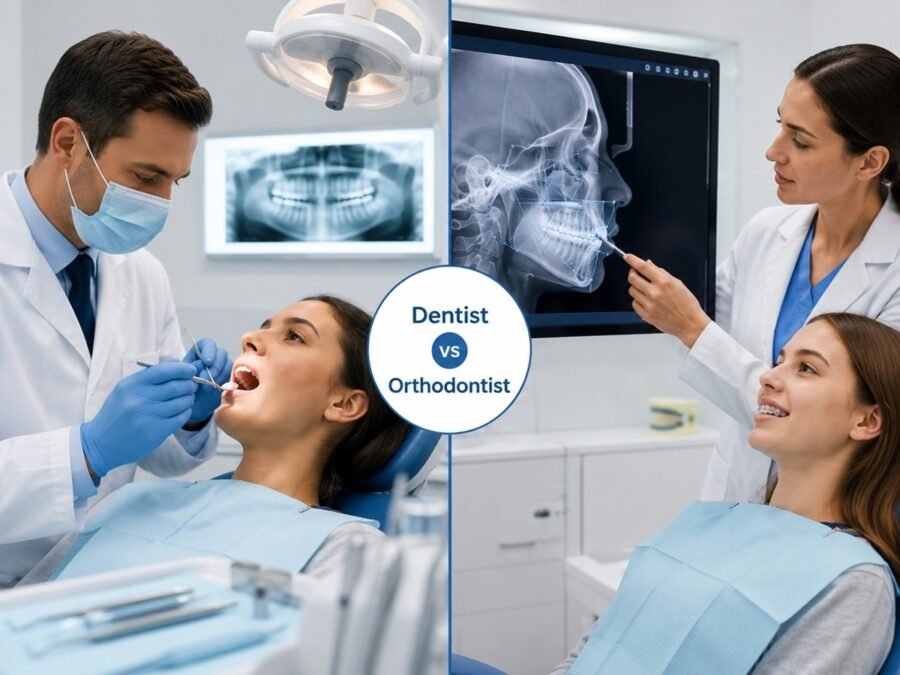
An orthodontist is a dental specialist who corrects the alignment of teeth and jaws using braces, clear aligners, and retainers. After completing a dental degree, they undergo 3 additional years of postgraduate training (MDS in Orthodontics) focused exclusively on diagnosing and treating malocclusion — the clinical term for a “bad bite.”
What Is an Orthodontist and What Do They Do?
An orthodontist diagnoses, prevents, and treats misaligned teeth and jaws — that is the full scope of their specialty.
Here is what that looks like in a real clinic, from someone who has spent over 12 years doing exactly this:
Every day, I see patients who walk in with crowded teeth, protruding front teeth, deep bites, open bites, or gaps between their teeth. Before I ever bond a bracket or fit an aligner tray, I do a cephalometric analysis — an X-ray-based measurement of the skull and jaw relationships that tells me whether the problem is in the teeth, the bones, or both. This is a step most people never even know happens.
Here is what orthodontists specifically do:
- Diagnose malocclusion — overbite, underbite, crossbite, open bite, crowding, spacing
- Design and place fixed braces — metal or ceramic brackets bonded to teeth, connected by wires
- Fit clear aligners — including Invisalign and other brands, using custom-fabricated plastic trays
- Use functional appliances — devices that redirect jaw growth in growing children
- Conduct cephalometric and panoramic X-ray analysis before starting any treatment
- Fit retainers — after active treatment ends, retainers hold teeth in their corrected position
- Coordinate with oral surgeons for skeletal jaw corrections in adults (orthognathic surgery cases)
According to the American Association of Orthodontists (AAO), orthodontic treatment does far more than improve smiles — it corrects bite problems that can cause jaw pain, uneven tooth wear, speech issues, and difficulty chewing.
In my practice, roughly 40% of patients come to me after first visiting a general dentist for braces or aligner treatment and then being referred out. That is not a criticism of general dentists — it simply reflects that orthodontics is a dedicated specialty requiring years of additional training.
What Is the Difference Between a Dentist and an Orthodontist?
Every orthodontist is a dentist, but not every dentist is an orthodontist.
That single sentence is the clearest way to understand this. Think of it like medicine: a cardiologist is a doctor, but not every doctor is a cardiologist.
Here is a direct comparison:
| Feature | General Dentist | Orthodontist |
|---|---|---|
| Basic Qualification | BDS (Bachelor of Dental Surgery) | BDS + MDS in Orthodontics |
| Years of Extra Training | 0 | 3 years postgraduate |
| Primary Focus | Overall oral health | Teeth and jaw alignment |
| Treats Cavities | ✅ Yes | ❌ Not typically |
| Does Root Canals | ✅ Yes | ❌ No |
| Performs Extractions | ✅ Yes | Only when needed for ortho |
| Places Braces | Sometimes (with short courses) | ✅ Yes — full specialty training |
| Fits Clear Aligners | Sometimes | ✅ Yes — with clinical diagnosis |
| Cephalometric Analysis | Rarely | ✅ Core of every treatment plan |
| Treats Malocclusion | Basic cases only | ✅ All complexity levels |
| Fits Retainers | Basic removable types | ✅ All types, custom-designed |
| Jaw Growth Management (children) | ❌ No | ✅ Yes — functional appliances |
The Dental Council of India MDS (Orthodontics and Dentofacial Orthopaedics) curriculum requires three years of full-time postgraduate education covering jaw growth, biomechanics, cephalometrics, and the clinical management of complex alignment cases. This is the foundation of what separates the two roles.
A general dentist is your first point of contact for dental health — cleanings, fillings, crowns, gum care, and extractions. An orthodontist is a referred specialist for alignment problems. Both are essential. They work together, not against each other.
What Is the Difference Between an Orthodontist and a Dentist — Who Should You See?
The simplest rule: see a dentist first for pain, infection, or general dental needs; see an orthodontist for crooked teeth, bite problems, or if you are considering braces or aligners.
Let me break this down practically, because I get this question almost every day at my clinic.
See a General Dentist if you have:
- A toothache, sensitivity to hot or cold
- A cavity or a broken tooth
- Swollen gums or signs of gum disease
- A dental abscess or facial swelling
- A need for a cleaning, crown, or extraction
- Any acute dental pain
See an Orthodontist if you have:
- Crooked, crowded, or overlapping teeth
- Gaps between teeth
- Front teeth that protrude (buck teeth)
- A deep bite (upper teeth cover lower teeth too much)
- An underbite (lower jaw is forward)
- A crossbite (upper and lower teeth don’t align side to side)
- You want Invisalign or clear aligners
- Your child’s teeth or jaw look like they’re developing unevenly
⚠️ Important: If you have throbbing pain, swelling or infection, see a general dentist first. Do NOT wait for braces. For safe home care before your visit, read our guide on the strongest natural antibiotic for tooth infection.
One thing I always tell patients: never delay treatment for infection while waiting for an orthodontic appointment. Active infection in the mouth must be cleared before any orthodontic treatment can begin anyway. Your general dentist handles that first. Then you come to me.
Can a Dentist Do Braces? The Truth
Yes, a general dentist can legally place braces — but whether they should depends entirely on the complexity of your case.
This is one of the most searched and most misunderstood questions in dental care, so let me be honest about it.
In India and in most countries, there is no law preventing a general dentist from placing braces. Some dentists complete short weekend courses or certificate programs in Invisalign or clear aligner therapy, and for simple, mild crowding cases, they may achieve reasonable results.
However, here is what those short courses do not teach:
- Cephalometric analysis and interpretation — reading skull X-rays to assess jaw relationships
- Jaw growth modification in children using functional appliances
- Mechanics of complex malocclusion — severe overbites, underbites, skeletal discrepancies
- Extraction-based orthodontics — knowing when and which teeth to remove to create space
- Orthognathic surgery coordination — cases where the jaw itself needs surgical repositioning
I spent three full years after dental school learning just these things. My MDS training under the Dental Council of India curriculum involved hundreds of supervised patient cases, biomechanics coursework, and learning to read a face — not just a mouth.
The AAO recommends that complex orthodontic treatment, especially in children and in cases involving significant bite problems, be managed by a trained orthodontist.
My recommendation: For mild crowding or minor spacing, a dentist offering aligner therapy may be appropriate. For anything involving a bite problem, jaw asymmetry, significant crowding, or a growing child — see a specialist.
After Braces – What About Small Chips or Gaps?
After braces come off, some patients notice small cosmetic imperfections — uneven edges, tiny chips, or slight size differences between teeth. This is not an orthodontic problem. It is a cosmetic one.
Here is something that surprises many of my patients: orthodontic treatment moves teeth into correct positions, but it does not reshape the teeth themselves. A tooth that was always slightly chipped, or a lateral incisor that is naturally smaller than it should be — those remain after braces.
Many patients finish braces and notice tiny chips or uneven edges. That is fixed not by braces but by composite bonding. Learn exactly what bonding is and how it differs from orthodontic work.
Composite bonding is quick, painless, and done by a general dentist or cosmetic dentist — not an orthodontist. It is one of the most common post-orthodontic finishing steps, and knowing about it beforehand helps patients set realistic expectations for their final result.
How Much Does an Orthodontist Cost in India vs USA 2026
Orthodontic costs vary widely based on treatment type, case complexity, and location — but here is a realistic comparison for 2026.
India
| Treatment Type | Estimated Cost (INR) |
|---|---|
| Metal Braces (full treatment) | ₹25,000 – ₹80,000 |
| Ceramic Braces | ₹40,000 – ₹1,00,000 |
| Self-Ligating Braces | ₹60,000 – ₹1,20,000 |
| Invisalign / Clear Aligners | ₹1,20,000 – ₹3,50,000 |
| Retainers (post-treatment) | ₹3,000 – ₹10,000 per set |
Costs are higher in metro cities (Mumbai, Delhi, Bengaluru) compared to smaller cities and towns. An MDS Orthodontist in a well-equipped urban clinic typically charges more than a general dentist offering braces, and rightly so — the diagnostic workup alone (OPG X-ray, cephalogram, study models) adds to the total.
USA
| Treatment Type | Estimated Cost (USD) |
|---|---|
| Metal Braces | $3,000 – $7,000 |
| Ceramic Braces | $4,000 – $8,500 |
| Invisalign (full) | $4,000 – $9,000 |
| Lingual Braces | $8,000 – $13,000 |
| Retainers | $150 – $600 per set |
In the USA, dental insurance may cover a portion (often up to $1,500–$2,000) of orthodontic treatment for children. Adults are less commonly covered. Many orthodontic offices in both countries offer monthly payment plans to spread the cost over the treatment duration (typically 12–24 months).
Key takeaway: Choosing the cheapest option is not always wisest. A misdiagnosed or undertreated malocclusion costs far more — in time, money, and dental health — to correct later.
Frequently Asked Questions
What is an orthodontist?
An orthodontist is a dental specialist with 3 years of postgraduate training (MDS or equivalent) beyond a basic dental degree. They specialise exclusively in diagnosing and treating misaligned teeth and jaws using braces, clear aligners, retainers, and other corrective appliances.
What is the difference between a dentist and an orthodontist?
A dentist provides general oral healthcare — fillings, cleanings, extractions, crowns, and gum treatment. An orthodontist is a specialist who focuses solely on tooth and jaw alignment. All orthodontists completed dental school first, then did additional specialist training. Not all dentists have orthodontic training.
What is the difference between an orthodontist and a dentist?
The difference is specialisation and training. Dentists handle overall oral health; orthodontists handle alignment problems specifically. If your concern is a crooked bite, protruding teeth, or you want braces or clear aligners — an orthodontist is the right choice. If you have tooth pain, a cavity, or gum disease — start with your general dentist.
What is an orthodontist and what do they do?
An orthodontist evaluates tooth and jaw alignment using X-rays and clinical examination, then designs a treatment plan using braces, Invisalign, functional appliances, or retainers to correct the problem. They treat malocclusion — the medical term for a misaligned bite — in children and adults.
Define orthodontist
An orthodontist is a licensed dental specialist who has completed a postgraduate degree (such as MDS Orthodontics in India or an equivalent residency abroad) in the diagnosis, prevention, and treatment of dental and facial irregularities, particularly malocclusion.
Can a general dentist do braces?
Yes, legally — but a board-certified or MDS-trained orthodontist has three or more years of additional specialist training in bite mechanics, jaw growth, and complex alignment cases. For anything beyond mild crowding, seeing a specialist is strongly recommended.
Written by Dr Chandra Sekhar, MDS Orthodontics | Member, Indian Orthodontic Society | Former General Dentist 12+ years in orthodontic practice. 3 years prior experience as a general dentist. Trained under the Dental Council of India MDS curriculum.
