

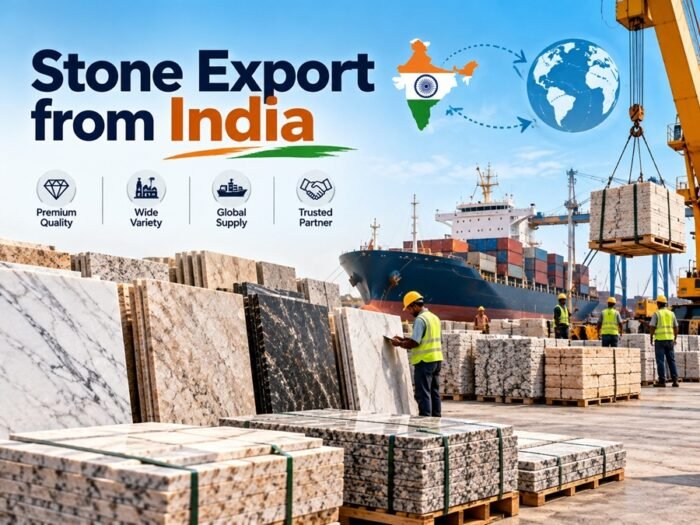
Quick answer: India exports natural stone worth over $2 billion annually, led by granite, marble, and sandstone. Rajasthan, Andhra Pradesh, Karnataka, and Tamil Nadu are the country’s biggest producing states. Buyers choosing an Indian stone exporter should check quarry origin, processing capability, and export certifications like IEC and RCMC before placing an order.
India has quietly built one of the world’s largest natural stone industries. Walk through any major city’s new commercial tower or luxury hotel lobby, and there’s a good chance the flooring or cladding came from a quarry in Rajasthan or a processing unit in Bangalore. Stone export from India isn’t a niche trade anymore — it’s a sector that employs over a million workers and supplies more than 150 countries.
For international buyers, though, the hard part isn’t finding a supplier. It’s finding the right one. Stone quality varies wildly depending on the quarry, the cutting technique, and even the season the block was extracted. This guide breaks down what you actually need to know: which stones India exports best, how quality gets graded, where the stone goes, and what separates a dependable exporter from a risky one.
What Makes India a Global Leader in Stone Export?
India ranks among the top three natural stone exporters globally, alongside China and Turkey. The country benefits from a rare geological advantage: a stone belt running through Rajasthan, Gujarat, Andhra Pradesh, Karnataka, and Tamil Nadu that produces an unusually wide variety of granite, marble, and sandstone types.
A few factors keep India competitive:
- Raw material abundance — India holds some of the largest granite reserves in the world, particularly in Andhra Pradesh and Tamil Nadu.
- Lower processing costs compared to European counterparts, without compromising on cutting precision in established processing hubs.
- Government support through schemes under the Ministry of Mines and export incentives administered by FIEO (Federation of Indian Export Organisations).
- Established trade relationships with the US, China, UAE, and several European countries built over three decades.
Which Stone Types Does India Export Most?
India’s stone export basket is dominated by three categories: granite, marble, and sandstone, each suited to different applications and price points.
Stone Type | Primary Source States | Common Uses | Typical Export Price Range (USD/sq.m) |
|---|---|---|---|
Granite | Andhra Pradesh, Tamil Nadu, Karnataka | Flooring, countertops, monuments | $15 – $60 |
Marble | Rajasthan (Makrana, Kishangarh) | Flooring, wall cladding, sculptures | $20 – $100+ |
Sandstone | Rajasthan (Jodhpur, Bansi) | Paving, landscaping, facades | $10 – $35 |
Limestone | Rajasthan, Madhya Pradesh | Flooring, construction aggregate | $8 – $25 |
Granite
Indian granite is prized for its color range — from the deep black of Absolute Black Granite to the speckled reds of Imperial Red. Tamil Nadu and Andhra Pradesh supply most of the export-grade blocks, with Bangalore and Hyderabad serving as major processing hubs. Granite’s hardness makes it a favorite for kitchen countertops and high-traffic flooring in commercial buildings.
Marble
Rajasthan’s Makrana marble has a historical pedigree — it’s the same stone used in the Taj Mahal. Today, Kishangarh in Rajasthan functions as India’s marble processing capital, home to thousands of cutting and polishing units. Indian marble competes directly with Italian and Turkish marble on price, though Italian marble still holds an edge in perceived luxury branding.
Sandstone and Limestone
Sandstone from Jodhpur and Bansi is widely used for garden paving and architectural facades because of its natural texture and weather resistance. Limestone, while less glamorous, remains a steady export category for construction aggregate and flooring in cost-sensitive markets.
How Is Stone Quality Graded Before Export?
Buyers often assume “Grade A” stone means the same thing everywhere. It doesn’t. In India, quality grading typically depends on four measurable factors:
- Water absorption rate — Lower absorption (below 0.4% for granite) indicates better durability, especially for outdoor applications.
- Compressive strength — Measured in MPa (megapascals); higher values mean the stone withstands heavier loads without cracking.
- Surface finish consistency — Polished, honed, or flamed finishes should show uniform texture across the full slab, not just the sample piece.
- Vein and color consistency — Especially critical for marble, where mismatched veining across slabs can ruin a large installation.
Reputable exporters provide lab test reports (often from CBRI Roorkee or private material testing labs) alongside each shipment. If a supplier can’t produce these on request, treat that as a warning sign rather than a minor gap.
Where Does Indian Stone Go? Key Export Markets
The United States remains India’s largest stone export destination, particularly for granite countertops used in residential and commercial construction. China buys significant volumes of raw granite blocks for domestic processing before re-export. The UAE, given its ongoing construction boom, imports marble and sandstone for hospitality and residential projects. European markets, especially Italy and the UK, import finished slabs for high-end interior design.
According to data tracked by India’s Ministry of Commerce, natural stone exports have consistently crossed $2 billion in value over recent years, with granite alone accounting for a substantial share of that figure.
What Challenges Do Stone Exporters Face?
Exporting stone isn’t as simple as loading a container and shipping it out. A few recurring challenges shape how buyers should plan their sourcing:
- Port congestion at Mundra and Chennai can delay shipments by weeks during peak seasons.
- Container shortages, a problem that worsened globally after 2020 and still causes periodic disruptions.
- Quarry depletion in certain regions, which pushes up prices for specific rare colors like Black Galaxy Granite.
- Quality inconsistency between small, unregistered quarries and established export-grade processing units.
Buyers who build in a 10–15% buffer on delivery timelines and work with exporters who have their own processing facilities (rather than pure trading middlemen) tend to avoid most of these headaches.
How to Choose a Reliable Indian Stone Exporter
Choose an exporter with their own quarry or processing unit if consistency across large orders matters more than the lowest possible price — trading companies without direct quarry access often can’t guarantee slab-to-slab matching. Choose a smaller trading exporter if you need flexibility across multiple stone types in a single shipment and don’t require tight color matching.
Before signing a contract, verify:
- Import Export Code (IEC) — mandatory for any legal exporter in India.
- RCMC (Registration-Cum-Membership Certificate) from the relevant export promotion council.
- FIEO membership, which signals the exporter operates within recognized trade norms.
- Sample shipment history — ask for references from past international buyers, not just photos of the quarry.
A supplier that hesitates to share these details is rarely worth the risk, no matter how attractive the quoted price looks.
Start Sourcing Smarter, Not Just Cheaper
Stone export from India offers genuine value for international buyers, but only when quality verification happens before the purchase order, not after the container arrives. Compare water absorption rates and compressive strength figures the same way you’d compare specs on any other industrial material. Ask for lab reports. Confirm export certifications. And whenever possible, work with exporters who control their own processing, since that’s where consistency actually gets built.
If you’re evaluating suppliers right now, start by shortlisting two or three exporters from different states — say, one from Rajasthan for marble and one from Tamil Nadu for granite — and compare their documentation side by side. The differences will tell you more than any sales pitch.
FAQs
What is the HS code for natural stone exported from India?
Natural stone exports from India generally fall under HS Code Chapter 25 and 68, with granite typically classified under 2516 and marble under 2515. Exact codes vary by processing stage (rough block vs. polished slab), so exporters should confirm the precise code with a customs broker before shipment.
How long does it take to export stone from India?
Depending on the port and destination, shipments typically take 20–45 days door to door, though port congestion at hubs like Mundra can extend this timeline during peak seasons.
Is Indian granite better than Chinese granite?
Indian granite generally offers a wider natural color range and comparable durability, while Chinese granite often has more standardized processing due to larger automated facilities. The better choice depends on whether color variety or processing consistency matters more for the specific project.
What documents are required to legally export stone from India?
Exporters need an Import Export Code (IEC), a Registration-Cum-Membership Certificate (RCMC), a commercial invoice, packing list, and a certificate of origin, along with any destination-country-specific import documentation.
Who are the major stone exporters in India?
Major exporters are concentrated in Rajasthan (marble and sandstone), Tamil Nadu and Andhra Pradesh (granite), and Karnataka (processed granite slabs), with most operating through established processing units rather than pure trading setups.
Must Read: How to Start a Profitable Tile Manufacturing Plant in India (2026 Guide)
