

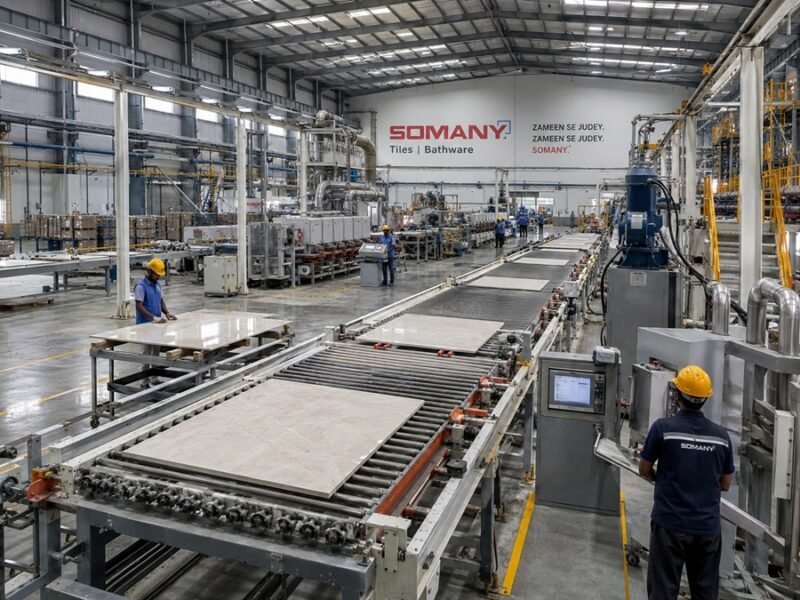
India’s construction sector is on a tear right now, and tiles are riding that wave. Every new apartment complex, metro station, office park, and highway rest stop needs flooring and wall cladding, and increasingly, builders are choosing tiles over marble or plain cement because tiles are cheaper, faster to install, and easier to maintain.
Three forces are pushing this demand higher. First, residential construction is booming across tier-2 and tier-3 cities, not just metros. Second, government programs like the Smart Cities Mission and PM Awas Yojana are driving large-scale infrastructure and affordable housing projects that consume tiles by the truckload. Third, Indian tile makers are increasingly exporting to the Middle East, Africa, and Southeast Asia, where Indian-made ceramic and vitrified tiles are seen as a good balance of price and quality.
For an entrepreneur or MSME owner, this creates a genuine opening. Tile manufacturing is capital-intensive, but it’s also a business with predictable demand, established supply chains for raw materials, and a well-documented technology base — meaning a first-time promoter doesn’t need to reinvent the wheel. If you’re evaluating whether to start a tile manufacturing plant in India, this guide walks through the entire journey: market size, machinery, licenses, costs, margins, and the practical challenges you should plan for before you sign any purchase order.
Quick Answer: A tile manufacturing plant is a small-to-large industrial facility that converts raw materials like clay, feldspar, and silica into ceramic, vitrified, or porcelain tiles through pressing, glazing, and firing. Setting one up in India typically needs anywhere from ₹50 lakh for a small unit to ₹25 crore or more for a large vitrified tile factory, depending on capacity and automation level.
Indian Tile Industry Overview
India is currently the second-largest ceramic tile producer in the world after China, and Gujarat’s Morbi cluster alone accounts for a large share of national output. The Indian tile industry has been growing at a healthy pace over the last several years, driven by real estate recovery, rising disposable incomes, and renovation demand in urban households.
Key industry trends worth noting:
- Digital printing has largely replaced older screen-printing methods, letting manufacturers offer marble-look, wood-look, and stone-look designs at a fraction of the cost of natural material.
- Large-format tiles (slabs) are gaining popularity for modern minimalist interiors with fewer grout lines.
- GVT and PGVT tiles are moving from premium-only to mid-market segments as production costs fall.
- Export markets are expanding, with Indian tiles increasingly shipped to the US, UK, Middle East, and African nations.
Major manufacturing hubs in India:
| Region | Specialization |
|---|---|
| Morbi, Gujarat | Ceramic, vitrified, and wall tiles — India’s largest cluster |
| Himatnagar, Gujarat | Ceramic and floor tiles |
| Thangadh, Gujarat | Glazed wall tiles |
| Andhra Pradesh & Telangana | Emerging vitrified tile units |
| Rajasthan | Natural stone and tile blending units |
If you’re scouting a location, being near an established cluster like Morbi has real advantages — easier access to skilled labor, machinery vendors, raw material suppliers, and logistics networks built specifically around tile production.
Types of Tiles You Can Manufacture
Choosing the right product mix at the start shapes your machinery investment and target customers. Here’s a practical breakdown:
Ceramic Tiles Made from clay fired at moderate temperatures, ceramic tiles are affordable and widely used for both walls and floors in residential projects. Lower capital requirement makes this a common entry point for new manufacturers.
Vitrified Tiles These are denser, less porous, and more durable than ceramic tiles because silica and quartz are vitrified (fused) at high temperature. They’re the preferred choice for high-traffic commercial and residential flooring.
Porcelain Tiles A premium subtype of vitrified tiles, fired at even higher temperatures for extreme durability, low water absorption, and resistance to weathering — ideal for outdoor and high-moisture applications.
Digital Printed Tiles Any tile category can carry digital-printed designs today. This technology lets a plant replicate marble, wood, or fabric textures with high precision, and it’s become close to standard in mid-to-premium tile lines.
Wall Tiles Lighter, glazed tiles designed specifically for vertical surfaces like bathroom and kitchen walls. They don’t need to bear foot traffic, so the body composition differs from floor tiles.
Floor Tiles Denser and more abrasion-resistant than wall tiles, engineered to withstand daily foot traffic and cleaning.
Outdoor Tiles Designed with anti-skid surfaces and higher frost/weather resistance for gardens, balconies, and building exteriors.
Parking Tiles Thick, heavy-duty tiles engineered for vehicle load-bearing in parking areas and driveways.
Double Charge Vitrified Tiles Two layers of colored material are pressed together, giving better design depth and wear resistance than single-charge tiles — a popular mid-premium segment.
GVT & PGVT Tiles Glazed Vitrified Tiles (GVT) and Polished Glazed Vitrified Tiles (PGVT) combine the strength of vitrified bodies with the glossy, design-rich finish of glazing — currently among the fastest-growing premium categories.
Why Invest in a Tile Manufacturing Plant in India
Key Takeaways:
- Urban housing demand is structurally rising, not a short-term spike
- Government infrastructure spending directly fuels tile consumption
- Export corridors to the Middle East and Africa are strengthening
- Established clusters mean machinery, raw materials, and skilled labor are readily available
India’s urbanization rate keeps climbing every year, and every new housing unit, office building, mall, hospital, or metro station needs floor and wall coverings. The Smart Cities Mission alone has triggered infrastructure upgrades across 100+ cities, and affordable housing schemes are adding millions of new residential units that need cost-effective flooring solutions — exactly where mid-range ceramic and vitrified tiles fit best.
Commercial construction — IT parks, retail complexes, warehouses — adds another steady demand stream, often preferring large-format vitrified and porcelain tiles for their durability. On top of domestic demand, Indian tile exporters are winning market share in regions where European tiles are too expensive and where Indian quality has improved enough to compete credibly. For an investor, this combination of steady domestic demand plus growing exports is what makes tile manufacturing an attractive long-term industrial bet, not just a trend to ride.
Raw Materials Required
Tile quality starts with raw material selection — this is where experienced manufacturers separate themselves from ones who cut corners.
- Clay: The primary body-forming material; ball clay and china clay are common grades, chosen for plasticity and firing behavior.
- Feldspar: Acts as a flux, lowering the firing temperature and helping vitrification.
- Quartz: Adds structural strength and controls thermal expansion in the fired tile.
- Kaolin: A refined white clay used for lighter-colored tile bodies and better whiteness.
- Silica Sand: Improves hardness and dimensional stability during firing.
- Dolomite: Used in glaze formulations and to adjust the firing curve.
- Pigments: Mineral-based colorants used in the tile body or glaze for consistent shading.
- Chemicals (binders, deflocculants): Control slurry viscosity during grinding and spray drying.
- Water: Used throughout grinding, mixing, and glaze preparation — consistent water quality affects batch-to-batch uniformity.
Quality tip: Sourcing raw materials from consistent, tested suppliers matters more than chasing the lowest price — inconsistent clay or feldspar batches are one of the most common causes of cracked or warped tiles during firing.
Manufacturing Process
Here’s the standard step-by-step tile manufacturing process:
- Raw Material Selection – Testing and blending clay, feldspar, quartz, and other inputs to the correct ratio.
- Crushing – Breaking down raw material lumps into smaller, uniform pieces.
- Grinding – Wet or dry milling (usually in a ball mill) to create a fine, uniform powder or slurry.
- Mixing – Blending the ground material with water and additives into a homogenous slurry.
- Spray Drying – Converting the slurry into a free-flowing granular powder, ready for pressing.
- Pressing – Hydraulic presses compact the powder into the tile’s raw (green) shape under high pressure.
- Drying – Removing residual moisture from the pressed tile before glazing.
- Glazing – Applying a glass-like coating for color, texture, and surface protection.
- Digital Printing – High-resolution inkjet printing applies the final design pattern.
- Firing – Tiles pass through a kiln at high temperature, fusing materials into a hard, durable body.
- Polishing – Mechanical polishing gives vitrified and porcelain tiles their glossy finish.
- Quality Inspection – Checking for size accuracy, surface defects, and water absorption levels.
- Packing – Sorting by grade and packaging for dispatch to dealers and distributors.
Each of these stages needs to be tightly controlled — a shortcut at grinding or drying, for instance, shows up later as cracked tiles at the firing stage, and by then the raw material cost is already sunk.
Machinery Required
| Machine | Purpose | Approximate Cost (₹) | Capacity | Maintenance Tips |
|---|---|---|---|---|
| Ball Mill | Grinds raw materials into fine slurry | ₹8–25 lakh | 5–20 tons/batch | Check liner wear regularly; replace grinding media on schedule |
| Spray Dryer | Converts slurry into dry granulated powder | ₹40 lakh–1.5 crore | 2,000–8,000 kg/hr | Clean nozzles frequently to avoid clogging |
| Hydraulic Press | Presses powder into tile shape | ₹50 lakh–2 crore | Depends on tile size and pressure tonnage | Monitor hydraulic oil levels and seals |
| Kiln (Roller/Tunnel) | Fires tiles at high temperature | ₹1.5–5 crore | Continuous line, varies by length | Regular refractory inspection; monitor burner efficiency |
| Glazing Line | Applies glaze coating | ₹30–80 lakh | Matches press output | Keep glaze viscosity consistent; clean bell/disc applicators |
| Digital Printing Machine | Prints design onto tile surface | ₹60 lakh–1.5 crore | High-speed inkjet, model dependent | Calibrate print heads; use filtered ink |
| Polishing Machine | Gives glossy finish to vitrified tiles | ₹80 lakh–2 crore | Line-speed dependent | Replace abrasive heads on schedule |
| Edge Cutting Machine | Trims tiles to exact dimensions | ₹15–40 lakh | Matches production line | Keep blades sharp and aligned |
| Packing Machine | Automates sorting and packaging | ₹10–30 lakh | Line-speed dependent | Regular belt and sensor checks |
| Material Handling Equipment | Conveyors, forklifts, storage systems | ₹20–60 lakh | Plant-wide | Routine lubrication and load checks |
Note: These are indicative figures for the Indian market and vary significantly by brand (Indian vs. Italian/Spanish machinery), automation level, and capacity. Always get updated quotations directly from machinery suppliers before finalizing your budget.
Land Requirement
| Plant Size | Approximate Land Needed | Typical Capacity |
|---|---|---|
| Small Plant | 0.5–1 acre | Up to 5,000 sq. meters/day |
| Medium Plant | 1–3 acres | 5,000–15,000 sq. meters/day |
| Large Factory | 3–10+ acres | 15,000+ sq. meters/day |
Recommended locations: Industrial estates near established clusters (Morbi, Himatnagar in Gujarat) offer better access to skilled labor, ancillary industries, and logistics. Look for locations with strong road/rail connectivity for both raw material inbound and finished goods outbound.
Utilities required:
- Reliable three-phase electricity supply (kilns and presses are power-intensive)
- Natural gas or LPG connection for kiln firing
- Adequate water supply and treatment/discharge facilities
- Effluent treatment plant (ETP) for pollution compliance
- Warehouse/godown space for raw materials and finished stock
Investment Required
| Component | Small Plant (₹) | Medium Plant (₹) | Large Plant (₹) |
|---|---|---|---|
| Land | 15–40 lakh | 40 lakh–1.5 crore | 2–8 crore |
| Building & Civil Work | 25–60 lakh | 1–2.5 crore | 3–10 crore |
| Machinery | 1.5–3 crore | 4–8 crore | 10–25 crore |
| Raw Materials (initial stock) | 5–10 lakh | 15–30 lakh | 50 lakh–1 crore |
| Electricity/Utility Setup | 5–15 lakh | 20–50 lakh | 1–2 crore |
| Lab Setup (QC testing) | 3–8 lakh | 10–20 lakh | 30–60 lakh |
| Working Capital | 15–30 lakh | 50 lakh–1 crore | 2–5 crore |
| Marketing & Branding | 3–8 lakh | 10–25 lakh | 40 lakh–1 crore |
| Transportation | 5–10 lakh | 15–30 lakh | 40 lakh–1 crore |
| Miscellaneous/Contingency | 5–10 lakh | 15–30 lakh | 40 lakh–1 crore |
| Estimated Total | ₹2–4.5 crore | ₹7–15 crore | ₹20–45 crore |
Quick Answer: Investment for a tile manufacturing plant in India ranges from roughly ₹2–4.5 crore for a small ceramic tile unit to ₹20–45 crore or more for a large automated vitrified tile factory, depending on land cost, capacity, and level of automation chosen.
These figures are indicative and vary by state, plot location, machinery brand, and automation level — always validate with local vendors and a detailed project report (DPR) before committing capital.
Licenses & Registrations
Setting up legally isn’t optional — and skipping steps here creates far bigger headaches once the plant is operational. Here’s what you’ll typically need:
- MSME/Udyam Registration – Establishes your business as an MSME, unlocking government schemes, subsidies, and easier loan access.
- GST Registration – Mandatory for any manufacturing business above the threshold turnover.
- Factory License – Issued by the state’s Factories Act authority; required before commencing operations.
- Pollution Control Board (PCB) Consent – Consent to Establish (CTE) and Consent to Operate (CTO) from the State Pollution Control Board, since kilns and effluent generation fall under regulated categories.
- Fire NOC – No-Objection Certificate from local fire authorities confirming safety compliance.
- Trade License – Issued by the local municipal corporation.
- BIS Certification – Bureau of Indian Standards certification for ceramic/vitrified tiles, important for credibility and government tender eligibility.
- ISO Certification – Optional but valuable for building trust with large builders and export buyers.
- Electricity Approval – Sanctioned industrial load approval from the state electricity board.
- Environmental Clearance – Required depending on plant size and category under environmental regulations.
- Lab Testing Accreditation – In-house or third-party lab testing to certify tile quality parameters (water absorption, breaking strength, etc.).
Quick Answer: Key licenses include MSME/Udyam registration, GST, a Factory License, State Pollution Control Board consent, Fire NOC, Trade License, and BIS certification. Environmental clearance and electricity load approval are also required before commercial production begins.
Manufacturing Cost Analysis
Production cost per square meter varies with tile type, size, and plant efficiency, but a rough breakdown for a mid-sized ceramic/vitrified plant looks like this:
| Cost Component | Approximate Share of Total Cost |
|---|---|
| Raw Materials | 35–40% |
| Labor | 12–15% |
| Power & Fuel | 20–25% |
| Packaging | 5–7% |
| Transportation | 5–8% |
| Maintenance | 4–6% |
| Administrative Expenses | 5–8% |
Power and fuel costs are consistently the biggest variable in a tile plant’s cost structure because kilns run continuously at high temperatures — this is why plant location (access to natural gas pipelines) directly affects long-term profitability.
Profit Margin
Key Takeaways:
- Gross margins in tile manufacturing typically fall between 25–35%
- Net margins after all overheads generally range from 10–18%
- Break-even is commonly achieved within 2–4 years for a well-run mid-sized plant
| Metric | Typical Range |
|---|---|
| Selling Price (per sq. meter) | ₹250–₹700 (varies widely by tile category) |
| Manufacturing Cost (per sq. meter) | ₹170–₹450 |
| Gross Margin | 25–35% |
| Net Margin | 10–18% |
| ROI | 15–25% annually (mature operations) |
| Break-even Period | 2–4 years |
Quick Answer: Yes, tile manufacturing is generally profitable in India, with gross margins around 25–35% and net margins of 10–18% once a plant reaches stable production. Actual profitability depends heavily on capacity utilization, power costs, and product mix.
These numbers are indicative industry ranges, not guarantees — actual margins depend on your specific product mix, plant efficiency, and regional market pricing. A detailed feasibility study specific to your location is essential before finalizing projections.
How to Market Your Tiles
Getting production right is only half the business — distribution determines whether that production translates into revenue.
- Dealer & Distributor Network: Build relationships with regional tile dealers who already have retail reach in your target markets.
- Builders & Developers: Direct tie-ups with construction companies for bulk supply on ongoing projects.
- Architects & Interior Designers: These professionals influence specification decisions on premium projects — building relationships here drives high-value orders.
- Government Tenders: Public infrastructure and housing projects regularly float tenders for tile supply; BIS certification is usually mandatory to participate.
- Export Markets: Middle East, Africa, and parts of Southeast Asia offer growing demand for Indian tiles — export requires additional quality certifications and logistics planning.
- Digital Marketing & SEO: A well-optimized website helps builders and dealers find you when searching for tile suppliers online.
- Google Business Profile: Essential for local visibility, especially for dealers searching for manufacturers near their region.
- LinkedIn: Effective for B2B relationship building with architects, builders, and procurement teams.
- Trade Exhibitions: Events like Vitrified India and Indian Ceramics are key venues for meeting dealers, exporters, and bulk buyers face-to-face.
Challenges and Solutions
| Challenge | Practical Solution |
|---|---|
| Intense competition from established clusters | Differentiate through design innovation, niche sizes, or eco-friendly positioning |
| High power costs | Explore natural gas connections, solar power for auxiliary loads, and energy-efficient kilns |
| Transportation costs and breakage | Invest in proper packaging and negotiate freight contracts with reliable logistics partners |
| Quality consistency issues | Implement strict raw material testing and in-line QC checkpoints at every stage |
| Volatile raw material prices | Build long-term supplier contracts and maintain buffer stock for key inputs |
| Environmental compliance | Invest early in ETPs and emission control systems rather than retrofitting later |
| Skilled labor shortage | Partner with local ITIs and offer structured on-the-job training programs |
Future Opportunities
- Large-Format Tiles/Slabs: Growing demand for seamless, minimalist interiors with fewer grout lines.
- Advanced Digital Printing: Continued innovation in design realism (marble, wood, fabric textures).
- Eco-Friendly Tiles: Recycled content and lower-emission firing processes are becoming a genuine market differentiator, not just a compliance checkbox.
- Export Growth: Expanding trade relationships open new international demand, particularly as global buyers diversify away from single-country sourcing.
- Premium & Luxury Tiles: Rising disposable incomes are growing the premium segment faster than budget categories.
- Automation: Robotic sorting, packing, and material handling reduce labor dependency and improve consistency.
- AI-Powered Quality Inspection: Machine vision systems are increasingly used to catch surface defects faster and more accurately than manual inspection.
- Smart Factories: IoT-enabled monitoring of kilns and presses is helping newer plants cut energy waste and downtime.
FAQs
1. What is a tile manufacturing plant?
A tile manufacturing plant is an industrial facility that processes raw materials like clay, feldspar, and silica into finished ceramic, vitrified, or porcelain tiles through crushing, pressing, glazing, and firing. It includes machinery for grinding, pressing, printing, and quality control.
2. How much investment is needed to start a tile manufacturing plant in India?
Investment ranges from roughly ₹2–4.5 crore for a small ceramic tile unit to ₹20–45 crore or more for a large, automated vitrified tile factory, depending on land cost, machinery choice, and production capacity.
3. Is tile manufacturing profitable in India?
Yes, tile manufacturing is generally profitable, with gross margins typically between 25–35% and net margins around 10–18% for stable, well-run operations. Actual profitability depends on capacity utilization and power costs.
4. How are ceramic tiles made?
Ceramic tiles are made by grinding clay and other raw materials into powder, pressing it into shape, drying, glazing, printing a design, and firing it in a kiln at high temperature to harden the final product.
5. Which licenses are required to start a tile factory in India?
Key licenses include MSME/Udyam registration, GST, a Factory License, State Pollution Control Board consent, Fire NOC, Trade License, and BIS certification, along with environmental clearance and electricity approval.
6. What machinery is needed for a tile manufacturing plant?
Core machinery includes a ball mill, spray dryer, hydraulic press, kiln, glazing line, digital printing machine, polishing machine, edge cutting machine, and packing equipment.
7. How much land is required to start a tile factory?
A small plant needs about 0.5–1 acre, a medium plant 1–3 acres, and a large factory 3 acres or more, depending on capacity and the type of tiles produced.
8. What is the difference between ceramic and vitrified tiles?
Ceramic tiles are made mainly from clay and fired at moderate temperatures, making them more affordable but slightly more porous. Vitrified tiles use silica and quartz fused at higher temperatures, making them denser, more durable, and better suited for heavy-traffic areas.
9. Can a beginner or MSME owner start a tile manufacturing business?
Yes, many successful tile manufacturers in India started as MSMEs. With proper planning, government MSME support schemes, and guidance from machinery suppliers, first-time entrepreneurs can enter this business, though a detailed feasibility study is strongly recommended first.
10. How long does it take to set up a tile manufacturing plant?
Setting up a plant typically takes 8–18 months, covering land acquisition, licensing, civil construction, machinery installation, and trial production, depending on plant size and approval timelines.
11. What is the break-even period for a tile manufacturing business?
Most well-managed mid-sized plants achieve break-even within 2–4 years, depending on capacity utilization, market access, and how quickly the plant reaches stable production volumes.
12. Is tile manufacturing export-friendly?
Yes, Indian tile manufacturers increasingly export to the Middle East, Africa, and Southeast Asia. Export requires additional quality certifications, consistent production standards, and reliable logistics arrangements.
Conclusion & Next Steps
Starting a tile manufacturing plant in India is a genuine business opportunity, backed by real demand from housing, infrastructure, and export markets. But it’s also a capital-intensive, technically detailed business where small mistakes in raw material sourcing, machinery selection, or compliance can be expensive to fix later.
Before you commit capital, take three concrete steps: get a detailed feasibility study done for your specific location and capacity, prepare a realistic business plan with conservative revenue assumptions, and have direct conversations with machinery suppliers and industry consultants who work in your target region. These steps won’t just protect your investment — they’ll also give you a much clearer, more confident path from planning to your first day of commercial production.
Disclaimer: Investment figures, cost ranges, and profit margins in this article are indicative estimates based on general industry patterns and can vary significantly by location, scale, automation level, and market conditions. Readers are strongly advised to commission a location-specific feasibility study and consult machinery suppliers, chartered accountants, and industry experts before making investment decisions.
