

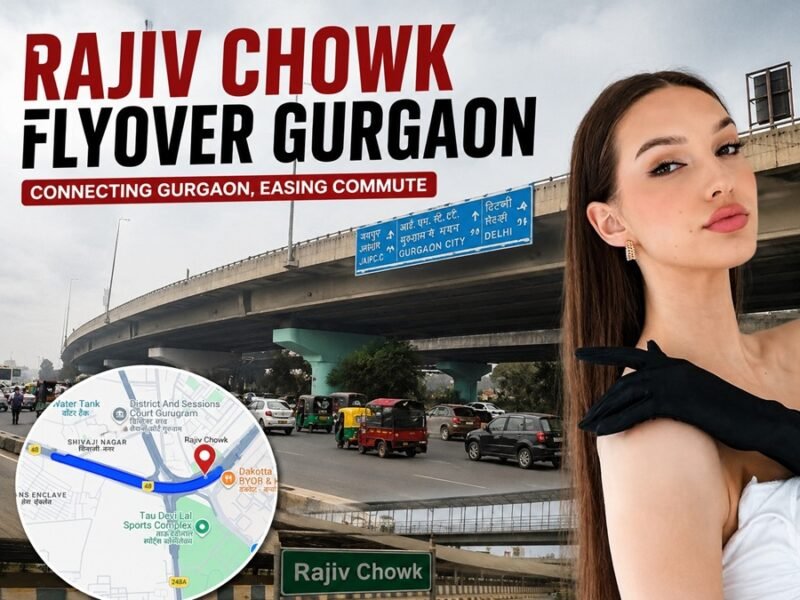
If you travel through Gurgaon regularly — whether for work, school, or daily errands — you already know what Rajiv Chowk feels like at 9 AM on a Monday. It’s one of those intersections where five minutes can turn into forty-five minutes without warning.
Rajiv Chowk in Gurugram sits right at the meeting point of some of the most important roads in the entire Delhi-NCR region. NH-48 (the Delhi-Jaipur Highway), Sohna Road, Old Railway Road, Civil Lines Road — they all converge here. And that’s exactly why it has been a traffic nightmare for years.
The good news? NHAI (National Highways Authority of India) has finally moved forward with a concrete plan: two new flyovers at Rajiv Chowk that will make signal-free movement possible between Sohna Road, Delhi, and the Sohna Highway.
This article gives you the complete picture — what the project is, why it’s happening, where things stand right now, and what changes you can expect as a daily commuter.
What is Rajiv Chowk Flyover?
The Rajiv Chowk Flyover Project refers to a proposal by NHAI to build two elevated flyovers at the Rajiv Chowk intersection in Gurugram, Haryana.
This isn’t just one flyover — it’s a dual-flyover plan designed to handle the two main traffic flows that currently choke the intersection:
- Flyover 1 — Starts from Sohna Road and moves toward the Hero Honda Chowk side before turning toward Delhi. This will allow vehicles coming from Sohna Road to travel directly toward Delhi without hitting a single red light.
- Flyover 2 — Begins near Sector 32 and provides direct movement toward the Sohna Highway. This is for vehicles coming from the Delhi-Jaipur Highway corridor heading toward Sohna.
Together, these two elevated structures will create grade-separated, signal-free corridors at one of Gurugram’s most congested intersections.
| Feature | Detail |
|---|---|
| Project Type | Dual Flyover (Grade Separated) |
| Location | Rajiv Chowk, Gurugram, Haryana |
| Authority | NHAI (National Highways Authority of India) |
| Land Required | ~3.05 Hectares |
| Roads Connected | Sohna Road, NH-48, Sohna Highway, Sector 32 Road |
| Traffic Type Addressed | Signal-free movement for Delhi-Sohna corridor |
| Current Status | Land identified; Haryana Govt approval pending |
Why Was Rajiv Chowk Flyover Needed?
Here’s the real story behind why this project matters.
Rajiv Chowk is the central nervous system of Gurugram’s road network. It connects:
- NH-48 (formerly NH-8) — the Delhi-Jaipur Highway that carries lakhs of vehicles every day
- Sohna Road — a fast-growing corridor packed with residential and commercial projects
- Old Railway Road — connecting central Gurgaon to the railway station
- Civil Lines Road — important for government offices and the district court area
- National Highway 248A — an alternate arterial road
Now imagine all of this traffic meeting at one point, controlled by traffic lights. That’s Rajiv Chowk — every single day.
The Problem Before the Flyover Plan
- Peak hour gridlock: During morning (8–10 AM) and evening (5:30–8:30 PM) peak hours, vehicles often wait 3 to 5 signal cycles just to cross the intersection.
- Multiple conflict points: Vehicles from five different directions merge without any grade separation, creating constant bottlenecks.
- Mixed traffic: Two-wheelers, autos, heavy vehicles, and buses all compete for the same space.
- Sohna Road congestion overflow: As Sohna Road’s residential sectors exploded with new residents and office-goers, the load on Rajiv Chowk increased dramatically.
- Delhi-bound bottleneck: Vehicles heading from Sohna Road toward Delhi had to sit through multiple signals, adding 15–30 minutes to daily commutes.
Urban planners and transport experts had been raising concerns about Rajiv Chowk for years. The rapid population growth of Gurugram — with new residential towers, tech parks, and commercial hubs springing up along Sohna Road and nearby sectors — made it clear that signal-controlled traffic management was no longer enough.
Latest Update — June 2026
Here’s what we know as of June 2026:
NHAI has completed land identification for the two flyovers. According to official sources, approximately 3.05 hectares of land has been mapped out for the construction work.
The proposal has been prepared and NHAI officials have confirmed they will submit it to the Haryana Government for necessary approvals. Once the government gives a green signal, the project will move into detailed engineering and execution phases.
At this stage, the project is in an advanced planning phase — not yet under construction, but moving meaningfully closer to ground-level work.
A draft feasibility report has already been prepared, which means NHAI has done significant homework on the structural design and traffic modeling. This is a good sign for the project’s credibility and seriousness.
Additionally, a double-decker viaduct concept has been proposed by GMRL (Gurugram Metro Rail Limited) for the Hero Honda Chowk–Umang Bhardwaj Chowk corridor that could work in coordination with the Rajiv Chowk flyovers — combining metro and elevated road infrastructure on shared pillars to avoid duplication.
In short: The project is real, the land is identified, and the government proposal is being finalized. Construction hasn’t started yet, but the groundwork is being laid.
Construction Timeline
| Milestone | Status |
|---|---|
| Traffic problem identified | Years in the making |
| Feasibility study initiated | Completed |
| Draft feasibility report prepared | Done |
| Land requirement assessed (~3.05 hectares) | Done |
| Proposal submission to Haryana Govt | Imminent (as of June 2026) |
| Haryana Govt approvals | Pending |
| Detailed engineering and design | To begin after approvals |
| Actual construction start | Not yet announced |
| Estimated completion | To be announced post-approval |
Opening Date — What We Know
As of June 2026, no official opening date has been announced for the Rajiv Chowk Flyover.
The project is still in its pre-construction stage — land has been identified and the proposal is being submitted to the Haryana Government. Once government approvals come through, NHAI will begin detailed engineering, which typically takes several months. Construction itself for a project of this scale usually takes 18–36 months.
Commuters should not expect the flyovers to be operational before 2028–29 at the earliest, though official timelines will only be confirmed after government approvals.
If the Haryana Government approves the proposal quickly, work could potentially begin in late 2026 or early 2027.
Practical note: Keep watching official NHAI announcements and Haryana Government press releases for confirmed timelines.
Current Traffic Situation
Right now, Rajiv Chowk remains one of the most congested intersections in Gurugram. Since the flyovers aren’t built yet, commuters are dealing with the same old problems:
Traffic at Rajiv Chowk Today
| Time Period | Traffic Condition |
|---|---|
| 7:00 AM – 10:00 AM | Heavy to Very Heavy (Office rush) |
| 10:00 AM – 12:00 PM | Moderate |
| 12:00 PM – 5:00 PM | Moderate to Heavy |
| 5:00 PM – 9:00 PM | Very Heavy (Evening rush) |
| After 9:00 PM | Light to Moderate |
| Weekends | Variable; heavy near malls and markets |
Specific Pain Points Right Now
- Vehicles from IFFCO Chowk to Rajiv Chowk face delays of 20–40 minutes during peak hours
- Sohna Road to Delhi traffic creates the worst bottleneck at the intersection
- Heavy vehicles on NH-48 frequently block lanes, slowing down all other traffic
- Roadwork and utility relocation along nearby corridors (like Hero Honda Chowk) sometimes spills over and affects Rajiv Chowk flow
The good news is that in 2025, Gurugram Police and NHAI launched a real-time alert system in partnership with Google Maps that provides speed limit warnings and hazard notifications to drivers, which has helped reduce accident-related jams on the NH-48 corridor.
Benefits for Gurgaon Traffic
Once the flyovers are built, the impact on daily commuting will be significant.
| Benefit | Current Situation | After Flyover |
|---|---|---|
| Sohna Road to Delhi travel time | 45–60 min peak | Expected 20–25 min |
| Signal stops at Rajiv Chowk | 3–5 signals/trip | Zero (signal-free corridors) |
| Delhi-Jaipur Highway flow | Bottleneck at Rajiv Chowk | Direct underpass/elevated movement |
| Commercial vehicle movement | Heavily delayed | Smoother transit corridor |
| Fuel wastage from idling | High | Significantly reduced |
| Air pollution from idling vehicles | High | Expected to reduce |
Key Benefits Explained
1. Signal-Free Movement The whole point of grade separation is to remove the need for traffic signals at key conflict points. Flyover 1 (Sohna Road to Delhi) and Flyover 2 (Sector 32 to Sohna Highway) will allow these two main flows to operate without interference.
2. Time Savings for Daily Commuters For the thousands of office-goers who travel from Sohna Road sectors to Delhi every morning, this could mean saving 20–30 minutes daily — that’s nearly 8–10 hours per month.
3. Reduced Fuel Consumption Vehicles that idle at signals consume more fuel. Signal-free movement means engines run more efficiently, which benefits both your wallet and the environment.
4. Economic Impact Smoother traffic means faster logistics for businesses, better last-mile connectivity for workers, and increased attractiveness of the Rajiv Chowk area for commercial investment.
5. Supporting Future Metro Integration The Rajiv Chowk area is being planned as part of Gurugram’s expanding metro and RRTS network. Better road infrastructure supports multi-modal integration and makes public transport more accessible.
Route Map Explanation
Here’s a simple breakdown of how the two proposed flyovers will work:
Flyover 1: Sohna Road → Hero Honda Chowk Side → Delhi
Direction: South to North
- Vehicles from Sohna Road sectors (Sector 33, 36, 37, 38 area) enter the flyover
- The elevated road curves toward the Hero Honda Chowk side
- Then connects directly onto the Delhi-bound carriageway of NH-48
- Who benefits: Residents of Sohna Road, students and workers heading to Delhi daily
Flyover 2: Sector 32 → Sohna Highway
Direction: North to South-East
- Vehicles coming from Delhi on NH-48 enter near Sector 32
- The flyover provides direct movement toward the Sohna Highway
- Bypasses the main Rajiv Chowk intersection entirely
- Who benefits: Vehicles traveling from Delhi-Jaipur Highway to Sohna, Bhiwadi, and beyond
Key Roads in the Zone:
- NH-48 — The main Delhi-Jaipur expressway running through
- Sohna Road — Major residential and commercial artery
- Old Railway Road — Connecting Rajiv Chowk to Gurgaon Railway Station
- Civil Lines Road — Government offices and administrative areas
- Jharsa Road — Local connector road
Nearby Metro Stations
Rajiv Chowk (Gurgaon) does not have its own metro station directly at the intersection. However, there are nearby stations that serve the area:
| Metro Station | Line | Approximate Distance from Rajiv Chowk |
|---|---|---|
| Millennium City Centre (HUDA City Centre) | Yellow Line | ~6–7 km |
| IFFCO Chowk Metro Station | Yellow Line | ~3–4 km |
| MG Road Metro Station | Yellow Line | ~5 km |
Practical Tip: Most commuters use IFFCO Chowk Metro Station as the nearest practical metro option, then take an auto or cab for the last stretch to Rajiv Chowk.
The upcoming Gurugram Metro expansion (under GMRL) plans to bring metro connectivity closer to central Gurugram areas, which could eventually provide better access to the Rajiv Chowk zone by 2027–28.
Nearby Landmarks
Rajiv Chowk is central Gurugram’s reference point. Here are the key landmarks in and around the area:
- Medanta — The Medicity (one of India’s largest hospitals) — just a few km away on Sohna Road
- Mini Secretariat, Gurgaon — Government administrative hub, very close to Rajiv Chowk
- Gurgaon Railway Station — Accessible via Old Railway Road directly from Rajiv Chowk
- Civil Court / District Court Gurugram — Connected via Civil Lines Road
- Rajiv Chowk Bus Stop — A major intercity bus stop with routes to Jaipur, Rewari, Bhiwadi, Delhi Airport, Faridabad
- Sector 32 & Sector 33 — Residential and commercial sectors adjacent to the flyover zone
- Shankar Chowk — Major nearby junction connecting to Cyber City and DLF areas
- Hero Honda Chowk — Key intersection on NH-48, about 4–5 km from Rajiv Chowk
Distance from Major Locations
| Starting Point | Distance to Rajiv Chowk | Approx. Travel Time (Normal) | Peak Hour Time |
|---|---|---|---|
| Delhi (Dhaula Kuan) | ~20 km via NH-48 | 30–40 min | 60–90 min |
| IFFCO Chowk | ~3.5 km | 10 min | 25–40 min |
| Hero Honda Chowk | ~4–5 km via NH-48 | 10–12 min | 20–35 min |
| Gurgaon Railway Station | ~2–3 km via Old Railway Rd | 8–10 min | 20–30 min |
| Dwarka Expressway (Sector 23) | ~12 km | 20–25 min | 40–55 min |
| Sohna (via Sohna Road) | ~20 km | 30–40 min | 50–70 min |
| Manesar | ~15 km via NH-48 | 20–25 min | 40–55 min |
Alternative Routes While Construction is Pending
Since the flyovers aren’t built yet, here are practical alternatives if Rajiv Chowk is heavily congested:
If going from Sohna Road to Delhi:
- Take the Dwarka Expressway route via Sector 23/Palam Vihar — this bypasses the NH-48 Rajiv Chowk bottleneck entirely for Delhi-bound traffic
- Use Southern Peripheral Road (SPR) to Golf Course Extension Road to reach NH-48 at a less congested point
If going from Delhi to Sohna:
- Exit at Iffco Chowk instead of Rajiv Chowk during peak hours
- Use the HUDA City Centre connector road to reach Sohna Road via Sector 29/30
General Tips:
- Leave before 8 AM or after 9 PM to avoid the worst peak hour delays
- Use Google Maps or Waze real-time routing — Gurugram Police’s integration with Google Maps (launched November 2025) now provides proactive hazard alerts
- If using public transport, IFFCO Chowk Metro is your best entry point, then auto/cab to Rajiv Chowk
- Intercity bus routes from Rajiv Chowk Bus Stop are a practical option for Rewari, Bhiwadi, and Jaipur travelers
Government Project Details
| Parameter | Details |
|---|---|
| Executing Authority | NHAI (National Highways Authority of India) |
| State Government | Haryana Government (approval required) |
| Local Authority | GMDA (Gurugram Metropolitan Development Authority) |
| Highway | NH-48 (Delhi-Jaipur Highway) |
| Land Requirement | ~3.05 hectares |
| Project Stage | Pre-construction (as of June 2026) |
| Feasibility Report | Draft prepared |
| Coordination Body | HMRTC for metro integration aspects |
About the Agencies Involved
NHAI (National Highways Authority of India): The central government body responsible for the development, maintenance, and management of national highways. All major flyovers on NH-48 fall under NHAI’s jurisdiction.
GMDA (Gurugram Metropolitan Development Authority): The city-level body overseeing Gurugram’s urban infrastructure, including road network planning, drainage, and development projects.
Haryana Government: State-level approval is required for land acquisition and funding, particularly since portions of the project area may involve state-managed land.
GMRL (Gurugram Metro Rail Limited): Involved in metro expansion planning and has proposed a coordinated double-decker viaduct concept between Hero Honda Chowk and Umang Bhardwaj Chowk, which could work in tandem with the Rajiv Chowk flyover project.
FAQs
1. What is the Rajiv Chowk Flyover Project?
It refers to NHAI’s plan to build two new elevated flyovers at the Rajiv Chowk intersection in Gurugram. These flyovers will create signal-free corridors between Sohna Road, Delhi, and the Sohna Highway, reducing traffic congestion at one of Gurugram’s busiest junctions.
2. When will the Rajiv Chowk Flyover be built?
As of June 2026, the project is in the planning and approval stage. NHAI has completed the land assessment and is submitting the proposal to the Haryana Government. No construction start date has been officially announced.
3. When is the Rajiv Chowk Flyover expected to open?
No official opening date has been announced yet. Based on typical infrastructure timelines in the region, commuters should expect the flyovers to be operational around 2028–29, assuming approvals are received in late 2026.
4. How many flyovers are being built at Rajiv Chowk?
NHAI has proposed two flyovers. One will handle Sohna Road-to-Delhi traffic, and the second will handle Delhi-Jaipur Highway to Sohna Highway traffic.
5. How much land is required for the Rajiv Chowk Flyover?
NHAI estimates that approximately 3.05 hectares of land will be needed for the construction of both flyovers.
6. Which government agency is responsible for the Rajiv Chowk Flyover?
NHAI (National Highways Authority of India) is the primary executing agency. The project also requires approval from the Haryana Government, and GMDA is involved at the city planning level.
7. Will the Rajiv Chowk Flyover be signal-free?
Yes. The entire purpose of these grade-separated flyovers is to eliminate signal stops for the two main traffic flows — Sohna Road to Delhi, and Delhi-Jaipur Highway to Sohna Highway.
8. Which road does the Rajiv Chowk Flyover connect?
The flyovers will connect Sohna Road to the Delhi-bound NH-48 carriageway (via the Hero Honda Chowk side), and Sector 32 / Delhi-Jaipur Highway to the Sohna Highway.
9. What is the nearest metro station to Rajiv Chowk Gurgaon?
The nearest practical metro option is IFFCO Chowk Metro Station on the Yellow Line, approximately 3–4 km away. Millennium City Centre (HUDA City Centre) is about 6–7 km away.
10. What is the traffic situation at Rajiv Chowk right now (2026)?
Rajiv Chowk remains highly congested, especially during peak office hours (8–10 AM and 5:30–9 PM). The flyovers are not yet built, so the intersection still runs on signal-controlled traffic. Commuters can use Google Maps with real-time hazard alerts (launched by Gurugram Police in November 2025) to navigate smarter.
11. Is there an underpass at Rajiv Chowk?
There are pedestrian subways at Rajiv Chowk that have been opened for use by two-wheelers and e-rickshaws for better local movement. However, a vehicular underpass as part of the flyover project has not been confirmed for this intersection.
12. How does the Rajiv Chowk Flyover relate to IFFCO Chowk traffic?
Both Rajiv Chowk and IFFCO Chowk are key congestion points on NH-48 in Gurugram. The Rajiv Chowk flyovers will reduce overflow that currently pushes back toward IFFCO Chowk during peak hours, improving traffic flow across the entire corridor.
Conclusion
Rajiv Chowk has been Gurugram’s traffic paradox for years — the intersection that connects everything but often delays everyone. The city has grown rapidly around it, with Sohna Road becoming one of Haryana’s busiest residential and commercial corridors, and NH-48 carrying increasingly heavy traffic between Delhi and the rest of Haryana and Rajasthan.
NHAI’s proposal to build two flyovers here is a genuine step forward. The land has been assessed, the feasibility study is done, and the proposal is heading to the Haryana Government. That’s meaningful progress — even if construction is still some time away.
For daily commuters, this project represents years of patience finally being acknowledged. For the city of Gurugram, it’s a necessary piece of infrastructure that the rapidly growing population has needed for a long time.
Keep tracking official NHAI and Haryana Government announcements for confirmed dates on approvals and construction start. Until then, plan your commute with the alternative routes and Google Maps real-time alerts described in this guide.
